In the winter and spring of 1873 Emily and John Dearman Birchall embarked on a five-month honeymoon trip to continental Europe, which Emily recorded in a diary. Despite the private nature of Emily’s writing (her diary was not edited and published until 1985) sex is strongly absent from the newlywed’s account. Perhaps this is unsurprising. Not only was twenty-year-old Emily a product of the moral strictures of Victorian propriety, to whom overt mention of sexual encounters would have been an anathema, but reference to sexual exploits are themselves atypical in travel writing. As Ian Littlewood notes, ‘The official line rarely tells the whole truth about anything, let alone sex. The story of tourism is no exception.’ (Littlewood, 2001, p.1) That said we do not need to be so accepting of this silence on questions of sex. Edward Brewtnall’s painting ‘Where next?’, painted in the decade following the Birchall’s wedding tour, illustrates how this kind of marital intimacy during travel could be played out; the husband’s possessive arm around his spouse’s shoulder; the luncheon table in disarray; the travel guidebook in the background; and the couple planning their route, perhaps not just for the afternoon, but given the painting’s title, also the rest of their lives. That Brewtnall’s painting is more commonly called ‘The Honeymooners’ makes it an appropriate accompaniment to Emily Birchall’s account. As with the painting’s imagery, by reading between the lines of Emily Birchall’s diary, we can reveal moments of physical desire and intimacy. I’d like to suggest that there are instances in Emily’s account which mention physical exertion, the ecstasy of particular views and scenery and her obsession with recording food and dining, which are signifiers for her sexual attraction to her new husband, even if they appear far removed from acts of sex themselves. In this discussion I will focus on one specific episode to explore how sexuality could be read into what seems like an ordinary tourist experience.

Travel, sex and intimacy
Helena Michie argues that in the nineteenth century Britons viewed mainland Europe as a terrain where pleasure and passion were to be anticipated. In the British imagination the very notion of Europe was ‘metonymy for sexualized, if not sexual, experience.’ (Michie, 2001, p. 237) Therefore, despite the Birchalls’ travel under the sanctioned state of matrimony, their wedding tour brought with it connotations of sexual transformation, particularly for Emily, whose sexually-naïve and virginal state on marriage would have been assured as a middle-class Victorian woman. The very concept of the honeymoon was a journey of transformation in terms of status, identity and physical maturity often conducted away from the familiar and the familial environment of home. Added to this is the sense that travel can be a context and facilitator of sexual desire, indeed, Littlewood maintains that ‘the physical business of travel is itself erotically charged’ and British travellers and tourists perceived that the further south in Europe one went the more Latin and sexually-charged the context became. (Littlewood, 2001, p. 3)
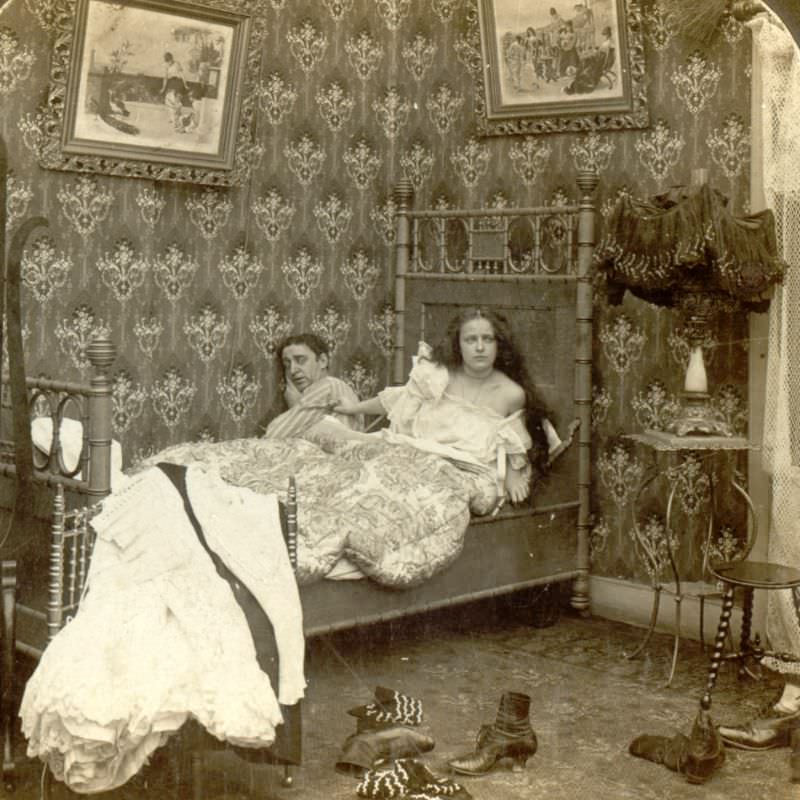
Red letter days on a continental wedding tour
The impact of these southern latitudes on Emily’s inhibitions to write about her experiences can be witnessed in her account of Tuesday 4th February 1873, by which point the Birchall’s had reached the French Riviera. Unlike many of her entries which open with mentions of breakfast, transport or the weather, Emily opened this date in emphatic style; ‘This has been one of the red letter days of my life, having been signalized by a glorious walk, in magnificent scenery, on an absolutely perfect day, and with a most congenial companion. What more could be desired?’ (Birchall, 1873, p. 9) Emily’s sense of euphoria is palpable and her allusion to a ‘red letter day’ marks it as one of those transformative moments which Michie links to the honeymoon. Her choice of words in describing the attributes of her day are also worthy of note; glorious, magnificent, perfect and possibly less enthusiastically, congenial. Congenial or pleasant seems out of sync with her other effusive descriptions and it is here that we might read Emily being coy about her new husband. Such coyness accompanies a full day alone in each other’s company as the Birchalls undertake a walk between Nice and Mentone, a twenty-mile trip on foot across spectacular costal cliff paths. Not only are they removed from the public social world of the Riviera towns frequented by most tourists, but they dispense with the assistance of their guide Perrini, who had accompanied them from London, and embark on the day’s sightseeing as unchaperoned partners.
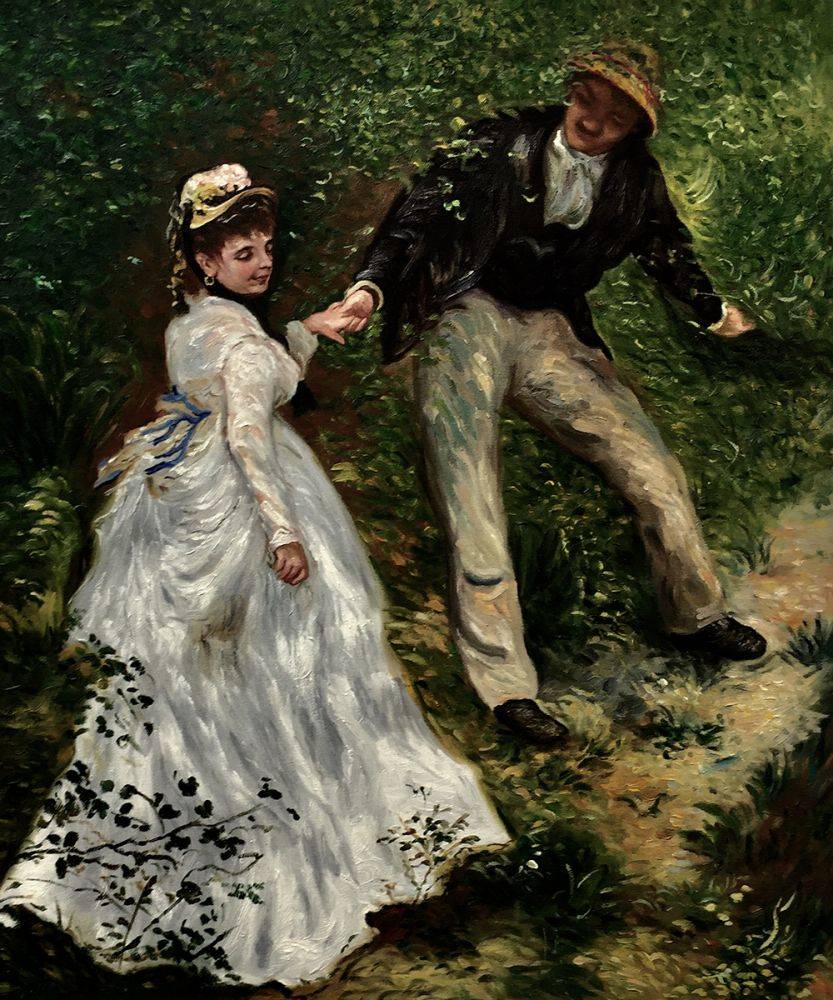
Reading intimacy into the deliciousness of a delightful walk
Emily’s description of the walk builds on this sense of herself and Dearman as a unit, underscored by her persistent use of ‘we’ in relating their actions and feelings. References to ‘we started … we found … we ventured … our eyes feasted’ (Birchall, 1873, pp.9-10) reflect what Claire Langhamer describes as marriage’s ‘dynamic emotional connection where personal transformation was a shared project achieved through togetherness.’ (Langhamer, 2013, p. 6) As they follow the steep costal path the Birchall’s are treated to amazing views of blue sea, green islands, rolling hills and snow-topped Alps in the distance; the couple see these vistas not as individuals but, Michie suggests, as part of a joint ‘conjugal gaze’ which commonly appears in the accounts of honeymooners abroad in this period. (Michie, 2001, p. 240) Moreover, in her details of such views, Emily makes special note of the olive orchards and vineyards which cover the surrounding countryside, both symbolically important in weddings and honeymoons as representations of fertility. In drawing her descriptions of this view to a close Emily pronounces that the panorama is ‘perfectly ravishing.’ (Birchall, 1873, p. 10 – italics mine)
But the sense of connectivity and shared appreciation of their surroundings is not the only hint of intimacy revealed in this particular extract. Emily’s choice of wording is again significant; ‘delicious … exhilarating … hot’ are adjectives which also carry connotations of romantic pleasure and arousal. (Birchall, 1873, p. 9) This is highlighted in her admission that she ‘doffed gloves and all doffable garments, and Dearman peeled to his shirt sleeves, greatly exciting my envy of his cool and airy appearance.’ (Birchall, 1873, p. 9) Whilst there’s no suggestion here that the couple removed more than jackets and accessories, even this act of casual semi-disrobing and the visual appreciation Emily pays to her husband bear witness to aspects of attraction and disregard for the sartorial expectations of the Victorian age. This sense of the couple’s playfulness is also echoed in Emily’s reference to ‘an awfully seedy looking restaurant’ in a small village where they stop for refreshment and ignore the niceties which usually accompanied their dining encounters in the best hotels amongst other rich and aristocratic tourist. (Birchall, 1873, p. 10) Taken together, these small actions compound 4th February as a day of particular frivolity, intimacy and escape for the Birchalls, removed from the public and touristic conventions which beset British newlyweds on honeymoon on the continent.

Assessing conjugal travel and the honeymoon period
From this discussion it would wrong to conclude that Emily and Dearman indulged in any sexual activity whilst on their long walk from Nice to Mentone, but if we read this diary extract carefully it becomes apparent that Emily’s account of the excursion is redolent with sexual connotations that are bound up with the experience of travel itself. This entry is suggestive of the ‘sustained tone of blissful intimacy’ which Emily sustains in the rest of her account. (Michie, 2001, p. 235) Once the honeymoon was over, five surviving children and an idyllic account of their home life depicted in The Dairy of a Victorian Squire (1983) point to a happy and productive marriage, founded on their five-months wedding tour in Europe.
Writing of another context in which open references to sex, even within marriage, are taboo, that of Muslim women’s autobiographies, Siobhan Lambert-Hurley has noted that ‘To interrogate a text for silences is a task expected of every careful scholar, and yet it can be marked by serious challenges. How exactly do we identify and then write about something that is not actually there in the script.’ (Lambert-Hurley, 2014, p. 159) Lambert-Hurley suggests that one way around this is to ‘start disentangling what an autobiographer chooses to tell about herself.’ (Lambert-Hurley, 2014, p. 160) Such a task is necessarily hampered by guesswork, but be analysing Emily Birchall’s diary entry for 4th February 1873 alongside other entries, closely attending to her choice of language and situating it in the wider context of travel and the Victorian honeymoon we can come to a fuller understanding of conjugal intimacy abroad.
Bibliography
Birchall, Emily (1873: 1985) Wedding Tour: January-June 1873. Gloucester: Alan Sutton.
Lambert-Hurley, Siobhan (2014) ‘To Write of the Conjugal Act: Intimacy and Sexuality in Muslim Women’s Autobiographical Writing in South Asia.’ Journal of the History of Sexuality 23(2), pp. 155-181.
Langhamer, Claire (2013) The English in Love: The Intimate Story of an Emotional Revolution. Oxford: OUP.
Littlewood, Ian (2002) Sultry climes: travel and sex. Da Capo.
Michie, Helena (2006) Victorian Honeymoons: journeys to the conjugal. Cambridge: CUP.
Michie, Helena (2001) ‘Victorian Honeymoons: sexual reorientations and the “sights” of Europe.’ Victorian Studies 43(2), pp. 229-252.
 Britons Abroad