There is a history of Dark Tourism amongst British travellers dating back hundreds of years, for example, the journey made to Scandinavia and the Nordic regions, which was often a popular spot for those travelling for the purpose of health and wellbeing, but alongside it ran a darker discourse, in which visitors often took trips to sites of famous battles and burials. The focus on Chernobyl as a site of Dark Tourism in todays day and age is arguably the opposite of a health and wellbeing trip, to an abandoned city and exclusion zone, still seeped in radiation from the 1986 disaster.
Dark Tourism is argued by some to be a recent phenomenon, for example Lennon and Foley who suggest that ‘tourist interest in recent death, disaster and atrocity is a growing phenomenon in the late twentieth and early twenty-first centuries’ (Lennon and Foley 2000, pp. 3). There could be other explanations however for why this seems to be the case. Firstly, the late 20th and early 21st century have seen rapid and vast technological advancements in terms of transportation. Low budget airlines allowed travellers to get around at a lesser expense. Ryanair relaunched as Europes ‘first low budget airline’ in 1990, running more flights at a lower cost to the consumer (Mark Tungate, 2017). The impact of media and the technological revolution that we have lived through also play a major role with the creation of the internet, mobile phones and the online media boom. There is a plethora of information available at our fingertips, be it via online articles or blog posts, film, television series, documentaries or gaming for people to engross themselves in things that they find intriguing. Chernobyl is a prime example of how the internet can create mass attraction in dark tourism.
Chernobyl certainly meets the label of a dark tourist spot defined by Seaton as ‘the desire to visit places inherently associated with death’ as the worst nuclear disaster in human history contaminating large areas of Ukraine, Belarus and Russia. (Seaton, 2009, p522). The official death toll directly linked to Chernobyl sits at just 31, which recognises the 31 first responders who died on the night of the disaster. Greenpeace infact put the real death toll at closer to 100,000 (Olivia Alabaster, 2019). The negative health impacts (cancer, leukaemia, circulatory diseases, and other chronic diseases) have so far claimed 600,000 lives of people in the contaminated zones (International Atomic Energy Agency 2006). It is no wonder that fans of the macabre are eager to visit. In 2013, some 8,000 tourists visited the Chernobyl exclusion zone. This rose to 65,000 by 2018, and as of 2019 the organisers expect up to 100,000 visitors following the launch of HBO’s ‘Chernobyl’. Currently, the Chernobyl tour is closed as a result of the Russo-Ukranian War, the site was even seized by the Russians at one point for just over a month, from the 24th of February until the 31st of March 2022. I am sure that if it was accessible to the public, there would still be some dark tourists that thrive off danger and thrill, who would still be more than willing to go and visit. This blog will discuss what sparks such popularity of a place like Chernobyl amongst dark tourists.

Statue dedicated to the official 31 first responders who lost their lives. Accessed via: https://www.insider.com/visiting-chernobyl-after-the-nuclear-disaster-2019-4#we-also-made-a-stop-by-the-fire-department-in-chernobyl-11
What makes Chernobyl unique as a tourist attraction?
Chernobyl as a dark tourism attraction is certainly unique. Frozen in time, the town of Pripyat is like stepping into a time machine back to the Soviet Era. The town reflects the communist way of life under the Soviet Union as it housed thousands of plant workers and their families (Olivia Alabaster 2019). It gives the tourists the opportunity to be immersed in history and also see the accumulation of nature over time whilst being at the site of the worlds worst nuclear disaster. For history fanatics, Pripyat provides the opportunity to visit a Cold War relic, suspended in time exactly as it was in 1986. It shows the Soviet Era in its final years of being… a haunting reflection of a superpower of the 20th century before it eventually crumbled.
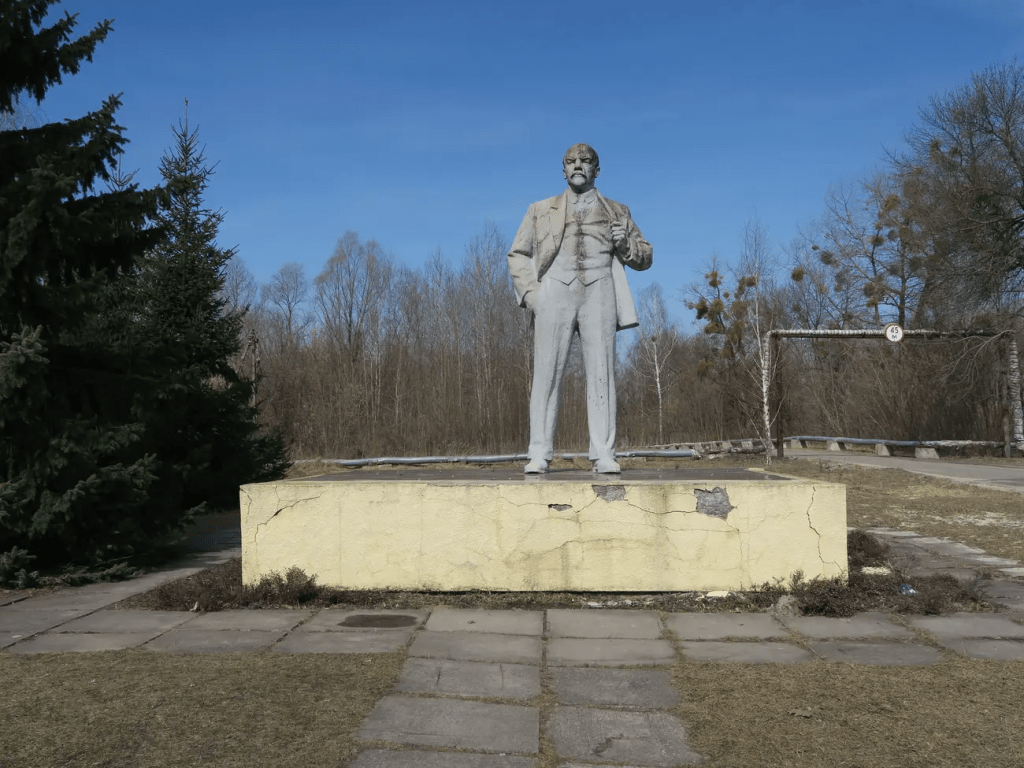
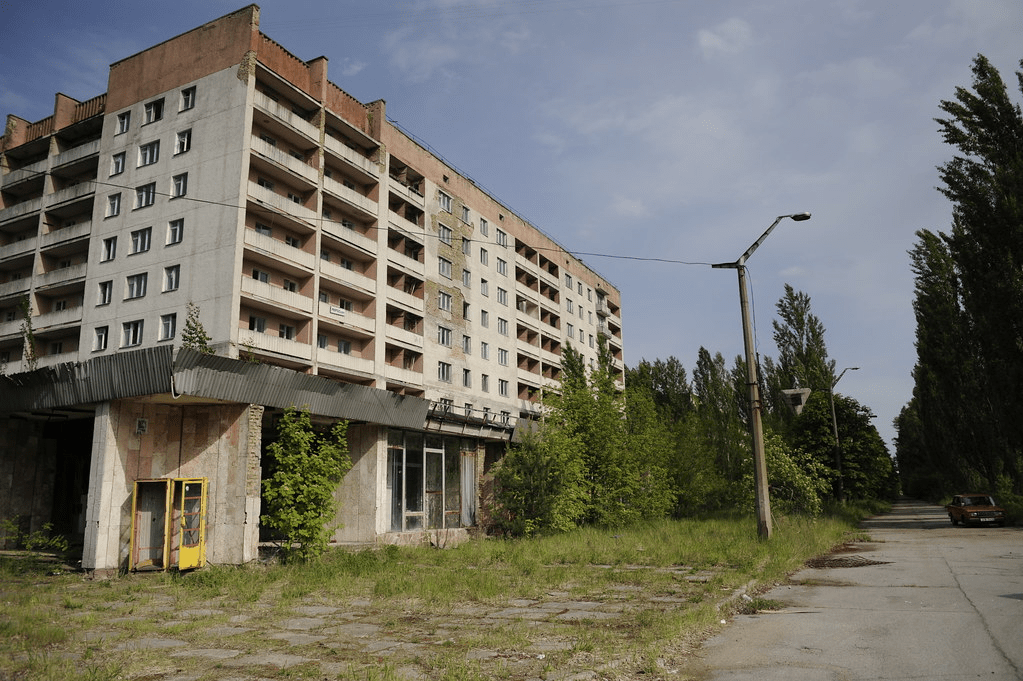
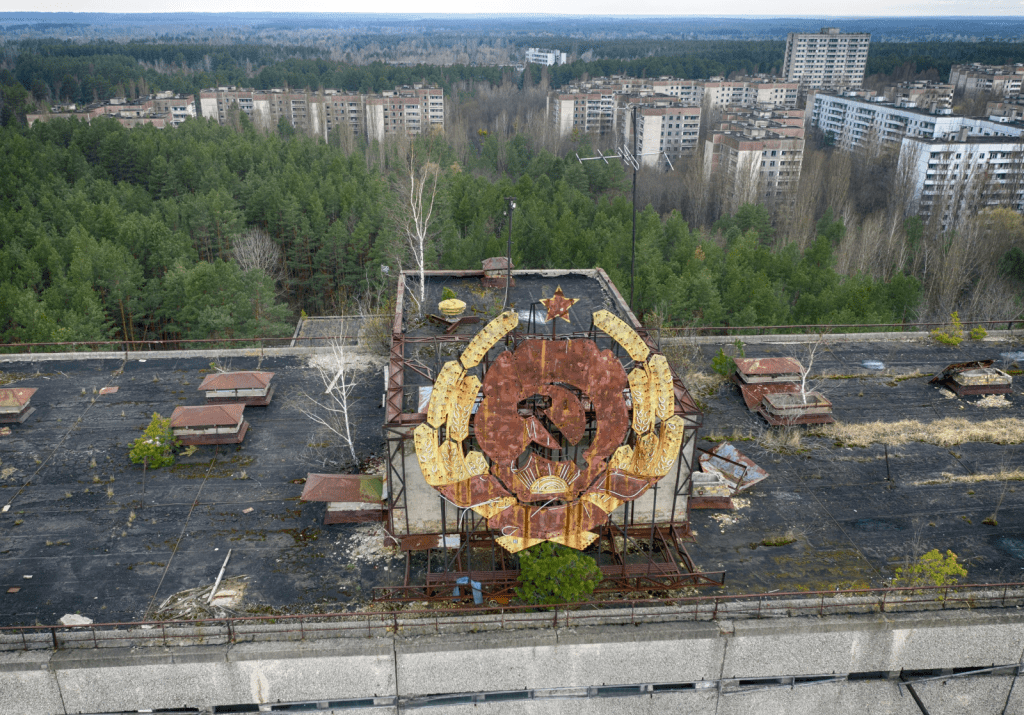
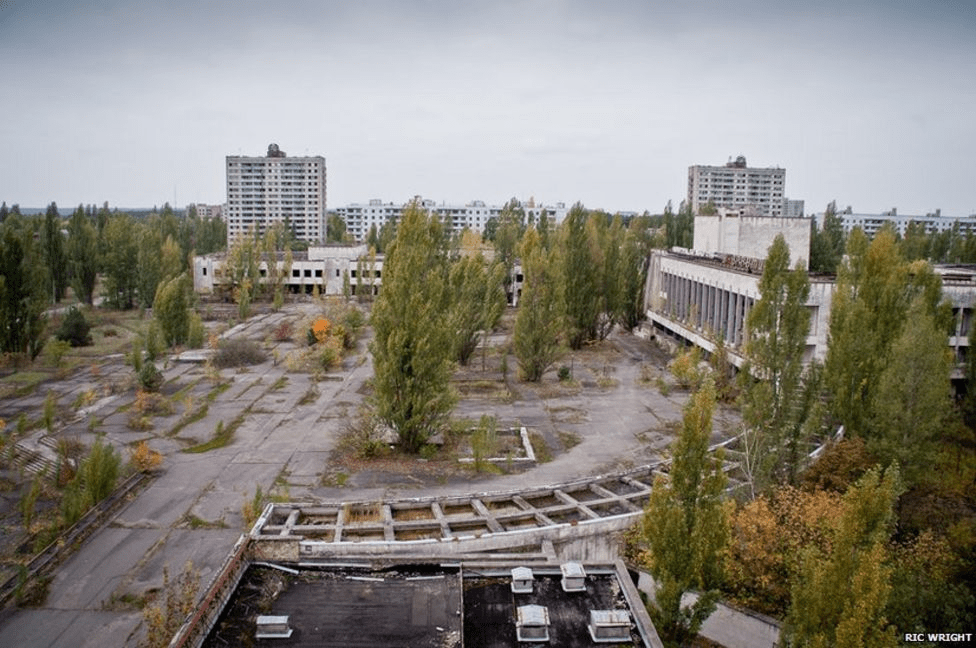
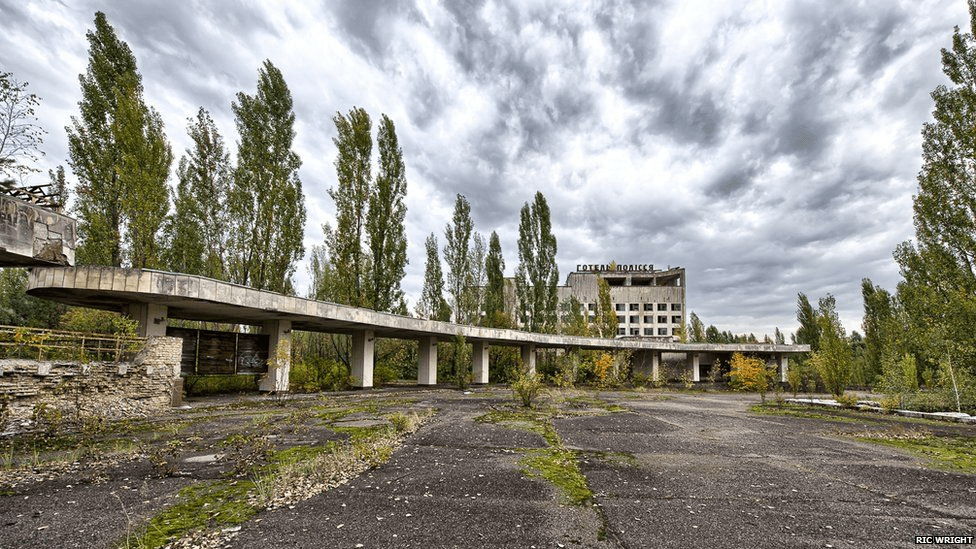
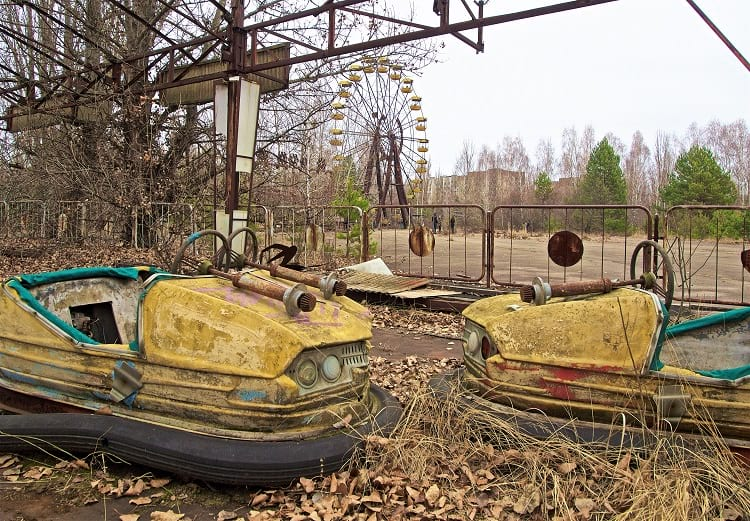
Image 1: ‘I saw a statue of Lenin.’ Accessed via: https://www.insider.com/visiting-chernobyl-after-the-nuclear-disaster-2019-4#the-architecture-and-monuments-of-the-area-were-a-step-back-in-time-10
Image 2: The deserted town of Pripyat, Chernobyl. 20th May 2008. Accessed via: https://www.flickr.com/photos/ebrd/9678672877
Image 3: The rusty emblem of the Soviet Union is seen over the ghost town of Pripyat close to the Chernobyl plant, Ukraine, 15 April 2021. (AP Photo). https://www.dailysabah.com/world/europe/more-than-3-decades-later-chernobyl-a-place-of-tragedy-and-hope
Image 4: Here you can see the Cultural Palace on the right, various other shops and restaurants and the 17-storey buildings in which most people lived. Each one is topped with a Soviet symbol. Available at: https://www.bbc.co.uk/news/in-pictures-22246328
Image 5: “Another way of looking at the desolation of Pripyat is how things could be in 27 years at other sites around the world, such as the area around Fukushima in Japan, as well as how the world would look after more than 25 years without human intervention, when nature reclaims cities”, said Wright. Available at: https://www.bbc.co.uk/news/in-pictures-22246328
Image 6: An abandoned amusement park in Pripyat. November 15, 2014. Accessed via: https://www.ststworld.com/pripyat-ukraine
Chernobyl could be seen as a reflection of anxieties that we have about the modern day world, as Stone describes Chernobyl as ‘a heterotopia that allows us to gaze upon a post-apocalyptic world, in which the familiar and uncanny collide’ (Stone, 2013, pp.91). Chernobyl is certainly a place where the familiar and uncanny collide, with the familiarity of a city structure, but the absence of bustling life and creativity you would expect. A heterotopia describes a space which has more layers of meaning or relationships that meets the eye. Chernobyl certainly fits the bill of a heterotopic place as its health implications spread out of Ukraine and into Belarus and Russia and still have impacts on the lives of people in this area of Eastern Europe 30 years later. Among residents of these countries, as of 2015 there were almost 20,000 cases of Thyroid cancer reported in children and adolescents exposed at the time of the accident. Approximately 5000 of these cases can be attributed to drinking milk from cows who ate grass contaminated with radiation in the weeks after the accident (Canadian Nuclear Safety Commission, 2022) This reflects anxieties that are apparent in 2023, with threats of Nuclear aggression often apparent in the news and media and also the crisis surrounding climate change. Chernobyl demonstrates to us what our planet would look like if Nuclear War materialised and the human race was wiped out, or if we do not act in time to save our planet from ourselves, putting into perspective how dangerous human beings are to our own existence. This is eerie even just to think about, let alone to walk around and experience for yourself. Although Chernobyl is perceived as a dark tourist site associated with death and disaster, it is fascinating to observe the way that nature had been able to flourish despite against the odds and take back the land, so it is possible to take away from the experience not only the tragic events that occurred at Chernobyl, but also a slither of hope for the future of our planet as nature defies all odds that humans cannot survive.

A classroom at one of the 21 schools in town. Accessed via https://www.bbc.co.uk/news/in-pictures-22246328

Pripyat’s concert hall now lies abandoned. Available via: https://www.bbc.co.uk/news/in-pictures-22246328

A public pool. November 4, 2017. Accessed via: https://www.ststworld.com/pripyat-ukraine/
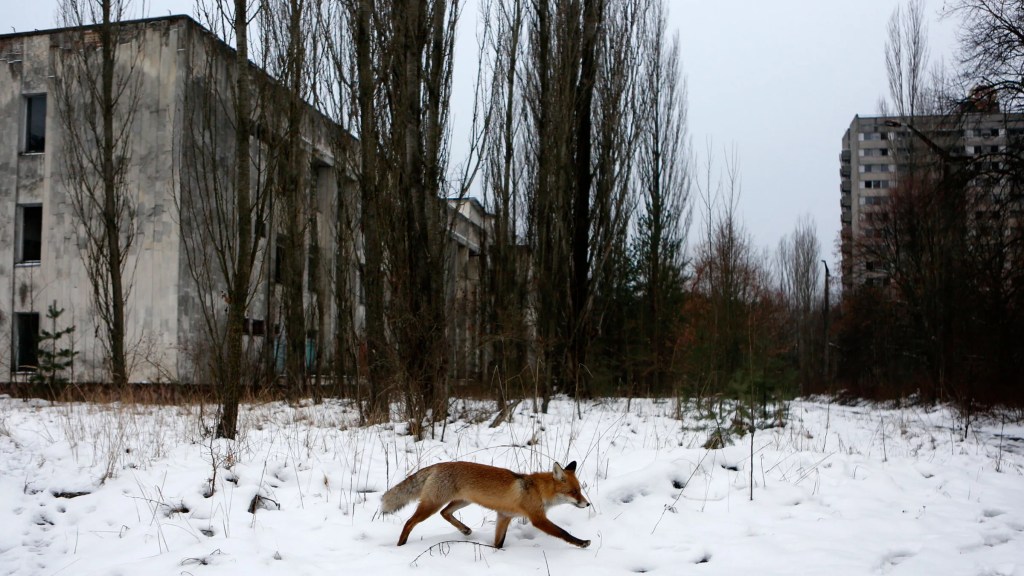
The Chernobyl Disaster May Have Also Built a Paradise. Accessed via: https://www.wired.com/story/the-chernobyl-disaster-might-have-also-built-a-paradise
The first tourists who had a desire to visit Chernobyl first began to arrive in the mid-1990s, once the radiation levels had fallen significantly, travelling mainly from the USA and Western Europe to visit the site (Hannam, K. and Yankovska, G, 2018, pp.207). Since this time the interest in tourism to Chernobyl has kept on growing. A trigger of interest in visiting the site which reflects the technological age we live in was ‘S.T.A.L.K.E.R: The Shadow of Chernobyl’, a 2007 first person survival shooter video game so it is no wonder this drew attention as gamers were able to experience the place they had seen in virtual reality, bringing it to life. The 2019 HBO series ‘Chernobyl’ was bound to have a similar effect. After watching the series, I found that it reflects the heartbreak of so many families whilst also delving into where the responsibility for the disaster lies and the legal proceedings that followed, it certainly made me eager to one day visit the site myself. It was reported that tourism companies experienced a 35-40% uptake in visitors (Katie Meller, 2019). This demonstrates the impact of technology and media on dark tourism in the modern day.
So how safe is it to visit Chernobyl?
Thrillseekers may enjoy the dangers associated with radiation when visiting Chernobyl, but how safe really is it to visit the site? In an interview with the Ukraines main radiation research hospital courtesy of Vice News, Larya Yanovych head of research analysis and planning department suggests that tourists who venture walk and go into buildings with vegetation, risk contamination of clothes and shoes and the danger of inhaling radioactive dust explaining that exposure to radiation can cause cell mutation and stimulate diseases your body is predisposed to. Generally though it is establised as safe to visit Chernobyl so long as tourists are respectful and the guidelines and stay on designated paths (Vice News, 2016, 6:06).
Summary:
Overall, Chernobyl is arguably the most famous and most popular Dark Tourism site in the Western World, and it is no wonder as it is extremely unique and like no other place on earth, like stepping into a time machine back to a day of disaster. It is clear that modern day technology and media has had a huge influence on the expansion of the Dark Tourism demographic, through film, TV and gaming in this instance, as well as the increased ease of travel in our modern day world.
Bibliography:
Primary Sources:
Canadian Nuclear Safety Commission (2022). Health Effects of the Chernobyl Accident – Canadian Nuclear Safety Commission. [online] Nuclearsafety.gc.ca. Available at: https://nuclearsafety.gc.ca/eng/resources/health/health-effects-chernobyl-accident.cfm.
https://www.bbc.co.uk/news/in-pictures-22246328
https://www.flickr.com/photos/ebrd/9678672877
https://www.ststworld.com/pripyat-ukraine/
https://www.wired.com/story/the-chernobyl-disaster-might-have-also-built-a-paradise
HBO (2019) Chernobyl (2019) | Official Trailer | HBO [Online Video]. 28th March. Available at: https://www.youtube.com/watch?v=s9APLXM9Ei8
International Atomic Energy Agency. (2006). Chernobyl’s legacy: Health, environmental and Socio-economic impacts and recommendation to the governments of Belarus, the Russian Federation and Ukraine. The Chernobyl forum 2003–2005. Vienna: International Atomic Energy Agency. Available at: http:// www.iaea.org/Publications/Booklets/Chernobyl/chernobyl.
Olivia Alabaster (2019) Dark Tourism: What is drawing thousands to Chernobyl and Cambodias killing fields? The Independent [Online], 03 July. Available from: https://www.independent.co.uk/news/long_reads/chernobyl-hbo-show-dark-tourism-auschwitz-killing-fields-cambodia-a8969611.html.
Vice News (2016) Holiday in Chernobyl: Tourism in the Exclusion Zone. [Online Video], 26th April. Available at: Holiday in Chernobyl: Tourism in the Exclusion Zone
Secondary Sources:
Hannam, K. and Yankovska, G. (2018) Tourism Mobilies, Spectralities, and the Hauntings of Chernobyl. In: Stone, P. R. et al. (eds) The palgrave handbook of dark tourism studies. London, United Kingdom: Palgrave Macmillan. doi: 10.1057/978-1-137-47566-4.
Katie Mettler (2019) Ukraine wants Chernobyl to be a tourist trap. But scientists warn: don’t kick up the dust. Washington Post [Online], 12 July. Available at: https://www.washingtonpost.com/travel/2019/07/12/ukraine-wants-chernobyl-be-tourist-trap-scientists-warn-dont-kick-up-dust/
Lennon, J. and M. Foley (2000) Dark Tourism: The Attraction of Death and Disaster. London: Continuum. Cited in: Bowman, M. and Pezzullo, P. (2009) “What’s so `dark’ About `dark Tourism’?: Death, Tours, and Performance,” Tourist Studies, 9(3), pp. 187–202.
Mark Tungate (2017) A brief history of Ryanair. Management Today. [Online], 9th November. Available from: https://www.managementtoday.co.uk/brief-history-ryanair/food-for-thought/article/1449458#:~:text=In%201990%2C%20Ryanair%20re%2Dlaunched,section%20of%20its%20own%20website.
Stone, P. R. (2013). Dark tourism, heterotopias and post-apocalyptic places: The case of Chernobyl. In L. White & E. Frew (Eds.), Dark tourism and place identity: Managing and interpreting dark places (pp. 79–93). London: Routledge.
 Britons Abroad