‘Surfing to me is more than just a sport, a culture, a way of life. It’s my medicine, my reset button, the thing I do to rediscover the best version of myself.’
Nick Hounsfield (The Wave, 2020).
The Birth of Surf
Back in the 1800s, the affluent south coast might just have been the birthplace of British surfing, with a rising trend of sea bathing. In 1890, we saw two Hawaiian Princes hitting the waves in the town of Bridlington. The chilly North Sea became the earliest confirmed wave riding in the UK, not the sunny surf hot spots like Newquay or Croyde. The birth of UK surf was in Bridlington, brought to us by Hawaiian royalty! Surfing had earned its title the ‘Sport of Kings’ thanks to its history with Hawaiian royalty. It was even dubbed ‘A Royal Sport’ in Jack London’s essay ‘Learning the Hawaiian Surfing’ because of the involvement of Kings and Queens, and yes, there were champion female surfers as well as male! Surfing even had some UK royal connections, with Edward Albert, Prince of Wales, dipping his toes in the sport. Under the guidance of Duke Kahanamoku, the Prince entered a royal jaunt to Hawaii in April 1920. Prince Edward fell in love with the sport and was often hailed as the father of modern surfing (Robinson, 2019).
Click here to learn about this image:
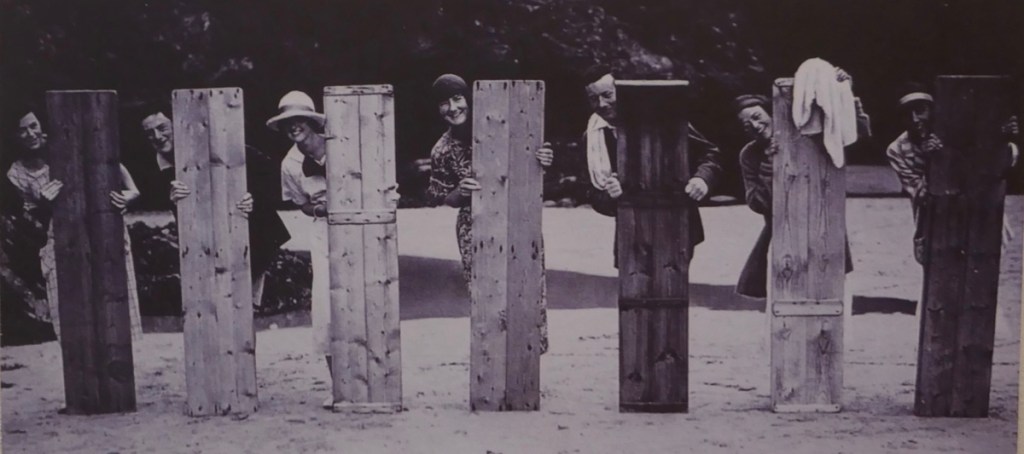
A group of friends, both female and male, hit the waves as far back as 1920 on a Cornwall beach. Believe it or not, these boards were crafted from modified coffin lids, each about five feet long (Robinson, 2019).
Click here to learn about this image:
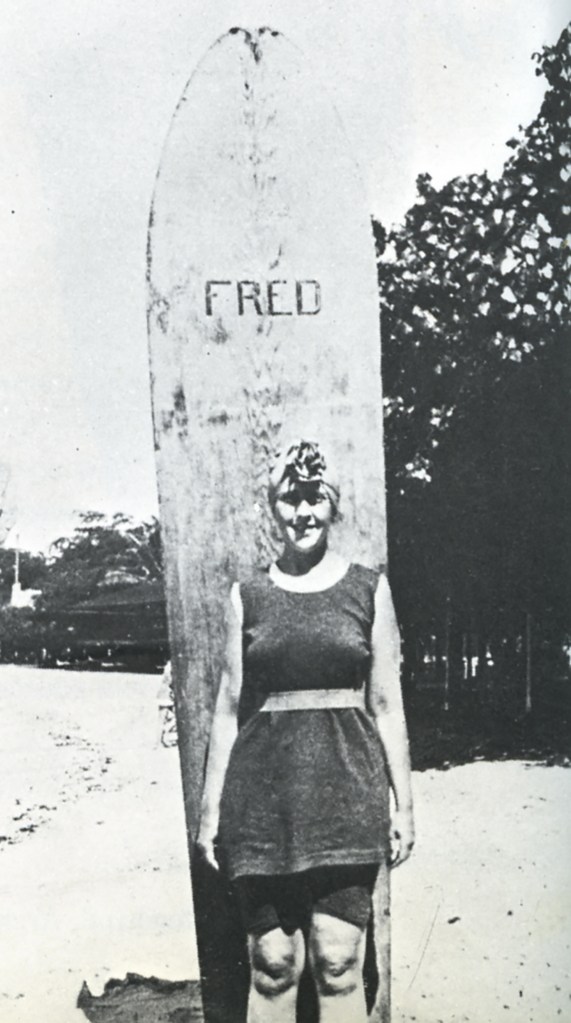
‘Oh it was heaven! Nothing like rushing through the water at what seems to you a speed of about two hundred miles an hour. It is one of the most perfect physical pleasures I have known.’
The crime writer Agatha Christie was one of Britain’s first surf girls. This picture was taken in 1923, where she began riding surfboards standing up, in Waikiki (Robinson, 2019).
The year is 1929, and a tight-knit group of Jewish immigrants set about building their own longboard, travelling from London, where they rode the waves of the West Country and the Channel Islands, to Newquay. Not only did they try their hand-or should I say feet- at standing up on their boards, but they also filmed their fun. And thanks to Sue Clamp, we all get a front row seat to this rare footage of history. Peter Robinson got the chance to chat with three of the OG surf gang in their mid-90s. Sure, their attempts at standing tall on their boards might not have been Olympic-worthy, but they paved the way for European surf culture (Surfer Today, n.d.).
reference:
(Surfer Today, n.d.)
We’re used to seeing sleek surf boards today. But those early boards? In 1934, they were four-foot smooth plywood planks, sporting a funky upturned nose. And the surfers bible of that year was Ronald Funnell’s ‘The Art of Surf Riding’-a roadmap to wave riding glory. It was full of tips on how to shred waves and pointed out all the best Surf spots across Britain (Robinson, 2019).
If you want to find out where today’s best spots are, click this link for an interactive map! (museum of british surfing, 2019).
1934 wasn’t just about guidebooks, it was also the year Britain’s first wave pool for surfing was made. The Duke of Gloucester cut the ribbon at the Empire swimming pool in Wembley, London (the ‘Sport of Kings’ indeed). As the years rolled on, coastal towns like Newquay in Cornwall and Woolacombe in Devon started cashing in on the surfing trend, plastering images of surfers on their guidebook covers to lure in the beach-loving crowds. The late 1950s saw things heating up on the surf front. After a spike in drowning incidents, Cornwall councils hired professional lifeguards to patrol the beaches. So along came the Australians and Americans to lend a helping hand. Their expertise birthed a whole new surf culture in the UK (Robinson, 2019).

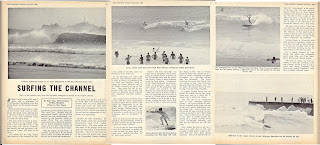
Click here for more information about the image on the Left:
The first article pictured is written by Ian Wilson, based in Newquay, in July 1964. The surf news? Bob and Bill were the go to high quality board builders in town, and they were in high demand. And for the Aussie readers, the waves had no sharks!(Lindsay, 2013)
Click here for more information about the image on the Right:
The second article pictured is written by Peter Troy in 1963, an Aussie travelling surfer reporting on Jersey. He writes how the local council are threatening to ban surfing because of its threat to bathers (Lindsay, 2013).
Click here to learn about this image:
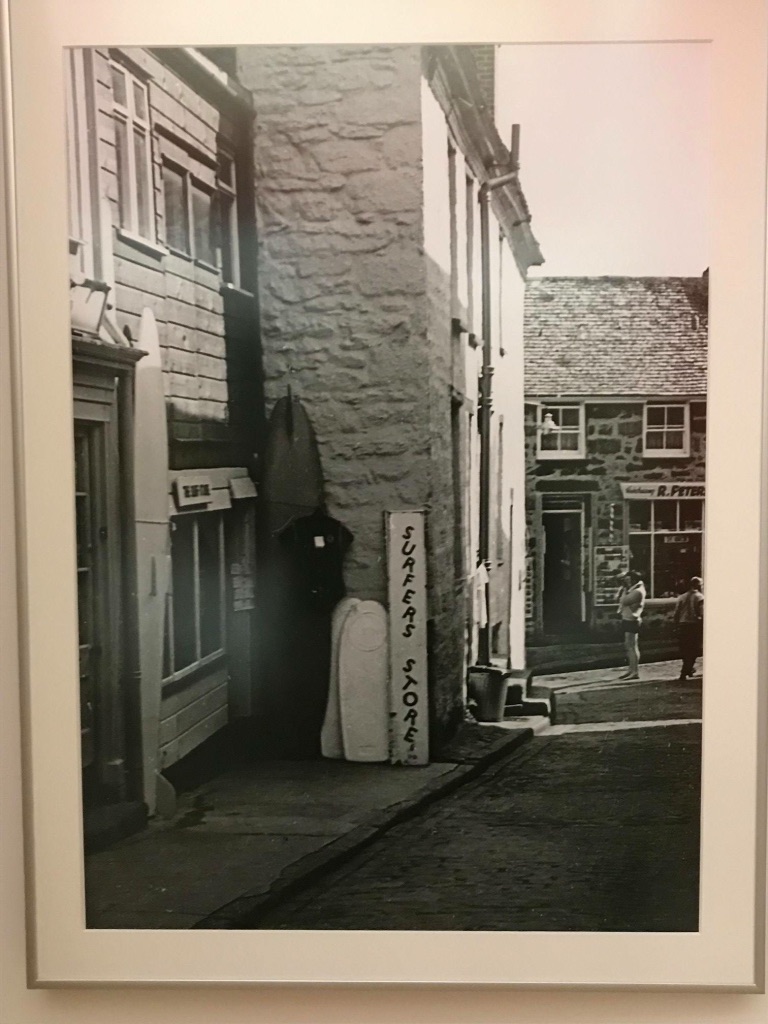
In 1963, Keith Slocombe opened Britain’s first surf shop in St Ives. Shortly after, other stores popped up in Hayle and Newquay, and so began a new era in British surfing culture (Robinson, 2019).
In the 2000s, stars like Russell Winter, Robyn Davies, and Sam Bleakley started touring the world. But it wasn’t just the pros catching waves: tens of thousands of us regular people were hitting up every coast across the seas (Robinson, 2019). From the sandy shores of Australia, British surfers have, and continue to, embark on sunnier adventures to seek out the perfect waves to ride and eagerly compete in international surfing competitions. Recently, surfing has made its debut in the 2020 Tokyo Olympics (Barwick, 2023). Now, many British surfers like to dip their toes in the French waves (Elliott, 2022).
‘The French road trip was always a rite of passage for UK surfers, that first road trip with your mates to score clean, warm and perfect summer waves leaving behind the weak chilly slop of the UK. This is something missed out on by the hero of our story. Morocco, Australia yes but never our closest neighbour.’
(Elliott, 2022)
To see more on the history of Surfing in the UK, here is an interactive timeline from the Museum of British Surfing.
Cornwall: the home of surfing
‘The expert rider takes off lying prone on his surfboard on the crest of a wave that is just breaking, and providing his timing is correct he will get a run of anything up to a hundred yards, at a speed of ten to fifteen miles an hour.’
(Newquay on the Cornish Coast, 1936)
As you drive into Newquay you are greeted by signs boasting ‘Coast of Dreams’, road signs are plastered with surf stickers and the streets are teeming with surfers. Especially in the summer months, this town is the epicentre of British Surf culture. But before 1962, you’d hardly spot a surfer on the beaches. It wasn’t until April 1962, when Australian lifeguards rolled into Newquay with fibreglass surfboards and The Beach Boys blared from radios, that surfing became popular. The demand for boards skyrocketed and Bob Head, Bill Bailey and Doug Wilson created European surf company Bilbo surfboards. But you had to prove yourself in the water before earning the right to own a surfboard. And to get yourself a board in Newquay, you had to track down Bill Bailey. It was sort of a rite of passage (Barber, 2017). The Brits were absolutely spellbound by the surfing scene. Before you knew it, more and more Brits were flocking to the beaches, ready to ride the wave (Wave, 2017). The Australians caught the surfing bug from a demo team from Hawaii and California in the 1956 Olympics. When they brought their skills to Cornwall’s shores, gone were the days of wooden belly boards (Booth, 2012).
‘It was an amazing thrill in the moment and, as it turned out, a life-forming experience for me. The elder surf-riding peer group, who befriended me, had not been riding the Malibu’s for more than a year. My research, more than 40 years later, has confirmed that 1962 was the critical formative year, both for Newquay and several other significant North Cornwall communities.’
Roger Mansfield, author of The Surfing Tribe, a history of British surfing, reflecting on a moment in Newquay when he was an 11 year old kid in 1963 (Booth, 2012).
The 90s had the entire globe catching onto the surfing craze. It wasn’t just a sport anymore-it was a lifestyle, complete with its own booming industry. Seaside towns were bursting with people sporting vibrant surf gear. Surfing also had made its mark in the competitive arena too, turning this relaxing pastime into a full-blown sport. And with this, Newquay and other Cornish resorts quickly became every surfer’s dream playground (Wave, 2017). In the past decade, the town’s population practically explodes during the summer months, ballooning from 22,000 in the winter to 80,000 visitors per week when the sun’s shining (Barber, 2017).
Surf Therapy
‘More and more studies are being carried out to look at how and why being near water has a positive impact on our mental and physical health and well-being.’
(The Wave, 2020)
Surfing isn’t about catching waves anymore. Over the past decade, it has become a form of therapy for both the mind and body. In the UK, the NHS has recognised surf therapy as a tool to support children and young people facing mental health challenges. Even the police and Blue Light services have hopped on board. The Wave Project charity supports around 1,200 children and young people every year and they’re the only surf therapy charity in the world to be funded by a government health service (www.rmg.co.uk, n.d.). You don’t need to gain the benefits of surf therapy. ‘The best surfer is the one having the most fun.’ It’s not just about the skill, it’s about soaking up the fun that comes with it. Surf Therapy has shown huge success in helping people tackle PTSD and depression, while also aiding in physical recovery. Now, let’s get a little scientific. Biologist E. O. Wilson suggested in 1984 that humans have this innate bond with nature and water. It triggers positivity and reduces stress levels. Surfing combines physical activity with the soothing water. Surfing isn’t just a sport (The Wave, 2020).
If you are interested, here is a link to the wave project.
Bibliography
Images:
Lindsay, A. (2013). vintage surfboard collector UK: Who said there’s no surf in Britain ? [online] vintage surfboard collector UK. Available at: http://vintagesurfboardcollectoruk.blogspot.com/2013/02/who-said-theres-no-surf-in-britain.html [Accessed 29 Feb. 2024].
Robinson, P. (2019). UK Surf History – Interactive Timeline. [online] Museum of British Surfing. Available at: https://www.museumofbritishsurfing.org.uk/discover/uk-surf-history-interactive-timeline/.
Primary sources:
Museum of British Surfing (2020). Lewis Rosenberg surfing 1929. [online] http://www.youtube.com. Available at: https://www.youtube.com/watch?v=B9wJpzIu1aA [Accessed 29 Feb. 2024].
Newquay on the Cornish Coast. (1936).
The Wave (2020). Into The Blue: Blue Health and Surfing in the 21st Century.
Secondary sources:
Anon, (n.d.). The history of UK surfing started in 1929. [online] Available at: https://www.surfertoday.com/surfing/uk-surfing-history-started-in-1929.
Barber, R. (2017). Newquay Surfing: A History Of Britains Surf City From 1960 To Present! [online] newquayactivitycentre.co.uk. Available at: https://newquayactivitycentre.co.uk/blog/newquay-surfing-history/ [Accessed 28 Feb. 2024].
Barwick, T. (2023). GB SURFING: A NEW ERA ON THE WAVES. [online] Sport Industry Group. Available at: https://www.sportindustry.biz/news-categories/features/gb-surfing-a-new-era-on-the-waves/ [Accessed 29 Feb. 2024].
Booth, R. (2012). Wave hello: the birth of British surfing. [online] the Guardian. Available at: https://www.theguardian.com/sport/2012/aug/24/surfing-anniversary-cornwall-devon.
Elliott, J. (2022). An Idiot Abroad. [online] Longboarder Magazine. Available at: https://longboardermagazine.com/2022/08/an-idiot-abroad/ [Accessed 29 Feb. 2024].
Lindsay, A. (2013). vintage surfboard collector UK: Who said there’s no surf in Britain ? [online] vintage surfboard collector UK. Available at: http://vintagesurfboardcollectoruk.blogspot.com/2013/02/who-said-theres-no-surf-in-britain.html [Accessed 29 Feb. 2024].
Museum of British Surfing. (2019). Surf Spots – Interactive Map – Museum of British Surfing. [online] Available at: https://www.museumofbritishsurfing.org.uk/discover/surf-spots-interactive-map/ [Accessed 28 Feb. 2024].
Robinson, P. (2019). UK Surf History – Interactive Timeline. [online] Museum of British Surfing. Available at: https://www.museumofbritishsurfing.org.uk/discover/uk-surf-history-interactive-timeline/.
The Independent. (2005). Surfing: Making waves in the magazine market. [online] Available at: https://www.independent.co.uk/news/media/surfing-making-waves-in-the-magazine-market-517272.html [Accessed 29 Feb. 2024].
Wave, C. (2017). The History of Surfing in Newquay, Cornwall. [online] Cornish Wave. Available at: https://cornishwave.com/surfing-in-newquay-the-history/#:~:text=It%20all%20started%20in%201929.www.rmg.co.uk. (n.d.).
Surf’s Up – Surfing as therapy | Royal Museums Greenwich. [online] Available at: https://www.rmg.co.uk/whats-on/online/surfs-surfing-therapy [Accessed 29 Feb. 2024].
 Britons Abroad