The First World War brought with destruction and carnage, but this conflict is the one that was to turn killing machines into ones of pleasure. The Golden Age of Aviation (Pattillo, 1998, p. 11) was a period of progressive change between World War One and World War Two in which aircraft which were once dual winged wooden and slow biplanes which during the 1920s to 1030s were developed (Norton, 1921, p.3), to metal, fixed wing monoplanes, which were much faster than their predecessors. This advancement changed the direction of both military and commercial aviation.
It was during this period that Civil air travel boomed, many aircraft were developed to fly for much longer stints and to perform agile manoeuvres such as barnstorming displays. This was a result of the now useless aircraft and aviators that now had nothing to pursue due to the end of the war, the abundancy of such recourses led to aviators pushing boundaries, stunt planes became popular in the 1920s and the emergency of the transatlantic challenge seemed to captivate aviators. In this post we will discuss the ways in which aviation changed and developed in light of the First World War.
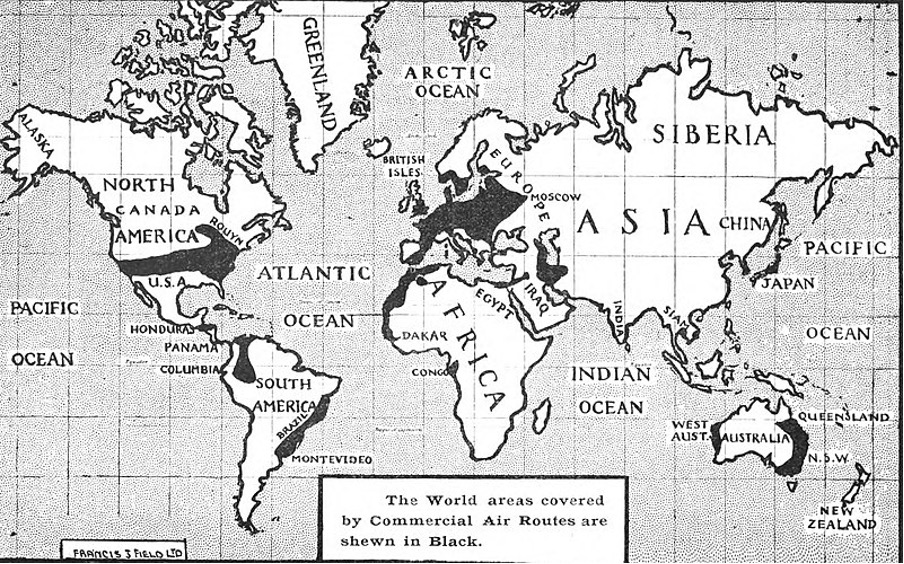
The World Areas Covered by Commercial Air Routes 1925.
The World areas covered by Commercial Air Routes 1925
From embryonic beginnings, crude and unadvanced planes designed by the likes of Romanian engineer Traian Vuia and Brazilian aeronaut Santos-Dumont, were shunned by the huge technological and engineering advances World War One brought about. Leading to planes much more adaptable to passenger transportation.
British Transatlantic Flights
In 1919 British Aviators, John Alcock and Arthur Brown made the first non-stop transatlantic flight in a modified First World War aircraft, the Vickers Vimy. This flight took place from Newfoundland, in eastern North America, to County Galway in Ireland. To further add to the list of new achievements, mail was also carried on this flight which also made it the first transatlantic mail flight, although it was only a small amount of mail. Winston Churchill, the then Secretary of state for Air awarded the two men with the Daily Mail Prize for the first transatlantic crossing by Air in “less than 72 consecutive hours” (The New Daily Mail Prize).
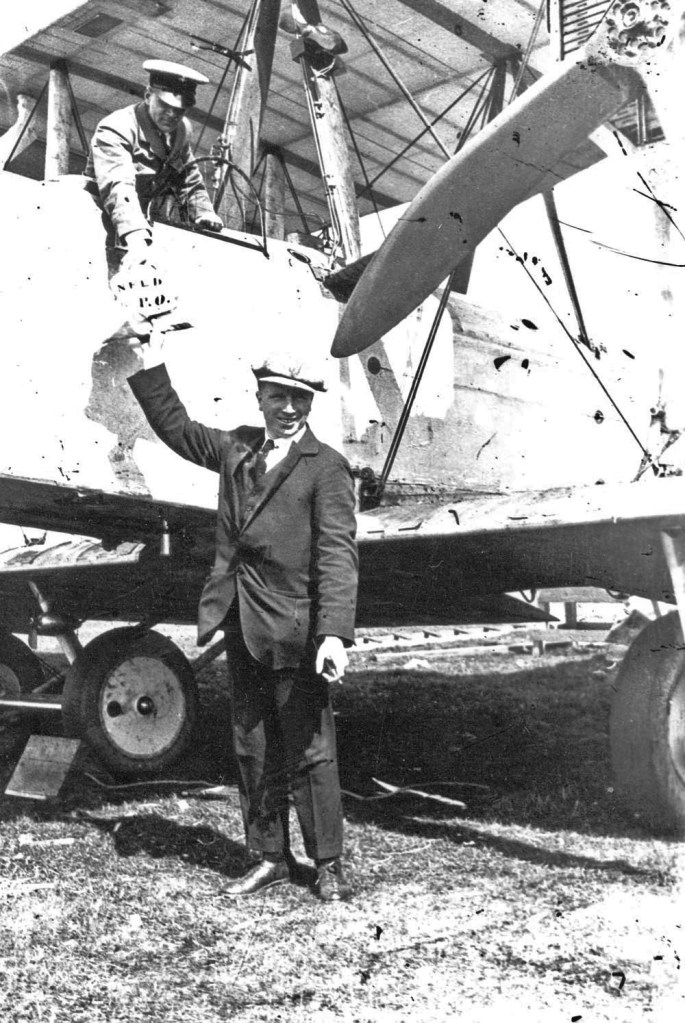
Alcock and Brown taking on mail
Civil Aviation in Britain
1919 saw the birth of civil aviation, the first international passenger plane in Britain took off on 25 August 1919 by company Aircraft Transport & travel, the route being between London and Paris (Lyth, 2000, p.866). This flight was followed by the Handley Page Transport Ltd, founded in 1919 by Frederick Handley Page, known to be a pioneer of the aviation industry (The New York Times).
Aircraft Transport & Travels (A&T) London to Paris flights cost only £15 (today) for a fare, although the priority for goods transportation at this time was not on the passengers, George Holt Thomas, the company’s founder is quoted saying; “it is our intention in the enterprise I control to concentrate almost entirely upon the carrying of mails rather than passengers” (Thomas, 1919, p. 187). During this first year, there were many new airlines established, this was made easy with the surplus of aircraft, pilots, and engineers due to the end of the war. It wasn’t until 1920 that demand, and business seemed to boom, but a trend, that is still seen today, rooted itself in the Civil Aviation industry. Many travellers sought destinations in the summer to escape Britain. In 1920, 3,000 passengers were carried to Europe from Briton between just July and September, but the entire year only saw the travel of around 6,700 passengers total, businesses suffered during the winter months the most (Civil Aviation Department). There was not enough demand and passengers to keep businesses alive, and slowly each one began to close down. Up until this point, civil aviation had had very little government backing, with Winston Churchill quoted saying “if commercial air transport was to fly, it must fly by itself”. But with the looming idea that if all Britain’s commercial air fleet was grounded, British travellers would have to rely on foreign airline operators for transport, as well as this Britain was the largest air power militarily wise and to have no air connections in the civil aviation sphere would be embarrassing. A grant was created by the Cross-Channel Subsidies Committee to grant Hanley and Instone a subsidy that. Today would be worth around £120,000, which would later be extended to a further company. But this subsidy only covered the London-Paris link, which was recognised as a mistake later. The grant was revised to cover multiple European link routes (Higham, 1959, p. 3). Over the next decade the civil aviation industry grew but was still rocky. Facing competition from the recovering railway and suffering from losses due to the unreliable and inefficient aircraft they were using, many companies struggled to even make a profit (Birkhead, 1960, p. 133). With no vision of the British air industry becoming unsubsidized, Sir Herbert Hambling was appointed to investigate British civil Aviation by the government. The committee recommended the merging of the four British Airlines. As a result of this committee report, competition was ended, and monopoly was brought into the industry and the companies merged into ‘Imperial Airways’ in 1924.
Glamour in Civil Aviation
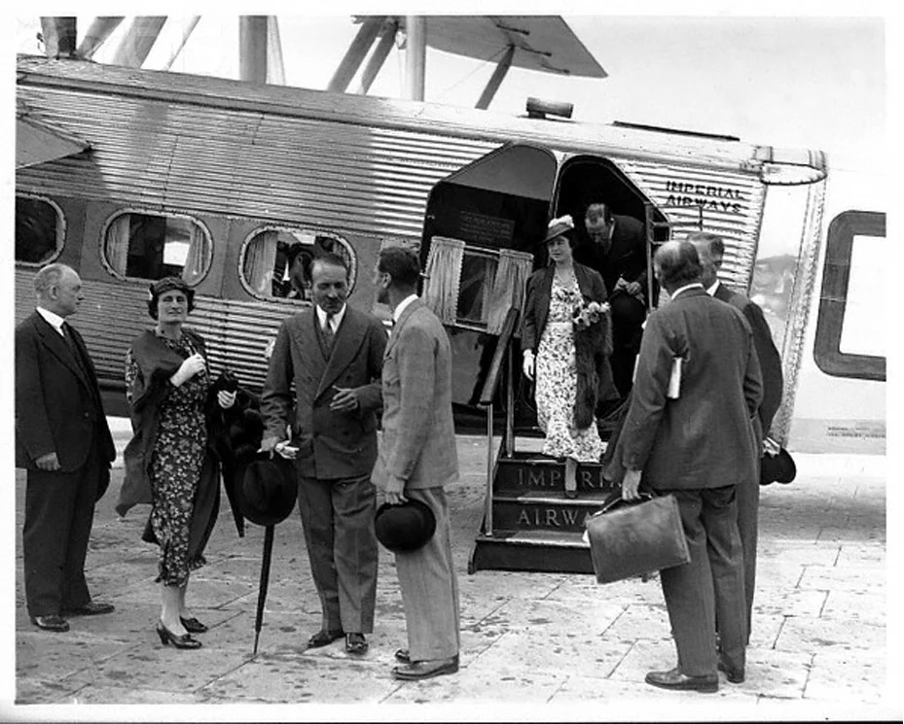
RAF Hendon Airport, London, 1937. Royalty arrives: King George VI, centre, and Queen Elizabeth on aircraft’s steps.
The glamour of air travel was heightened during the 1930s, the period was marked by class and prestige. The glamour of air travel was cemented during this time period with the event of King George V flying with the British airline, Imperial Airways. As discussed previously, Imperial Airways was the dominant airline at the time, it ran both passenger and mail carrying routes throughout the empire, these routes were established in the mid 1930s outlined in a speech given by Sir Eric Geddes at the annual meeting of Imperial Airways. (see below).
In 1936, King George V, along with the Queen Consort flew from London to Scotland aboard an Imperial Airways aircraft, marking a significant change from the usual Rail transportation favoured by the prestige, including the Royal family, for long distance travel. King George V’s choice to fly with Imperial Airways added elegance and glamour to the reputation of aviation. As well as this, the Kings choice of air travel also highlighted the “safety” of the form of transportation, which in turn increased its reputation to the public. Furthermore, given the large price tag attached to air travel at this time, it war primarily associated with officials, business individuals, the upper class and notably, Royalty (Giant British Airliner).
Although the glamour of aviation was not without its risks. Accidents occurred within the industry such as an accident in which two members of crew lost their lives in Mozambique Harbour 1939 (British Official Accident Report). Or the Cavalier accident of 22 January 1939 in which a storm resulted in the failure of the four engines of the Cavalier as a heavy storm iced over the carburettors. At 1:12PM Captain Alderson was forced to bring the plane crashing down into the Atlantic, the impact caused the joints of the plane to crack and it began sinking, with not a single life raft aboard, three cabin crew had life jackets and the plane was not fitted out with enough life belts for all of the passengers, it was a catastrophe that caused the loss of three lives (The Bermudian).
Cabin Glamour
Cabins upon the Imperial Airways airliners, HP. 42, were designed with elegance to mirror that of the luxurious designs of Pullman train carriages (Jackson, 1973, p. 238).
There were also two passenger cabins, with a capacity for six in the forward cabin and twelve in the rear cabin. The aircraft offered ample luggage storage as well as large windows for viewing, after all, many saw the journey itself as a tourist pleasure, they further offered spaciousness and attentive cabin staff (Marsh, 2014).
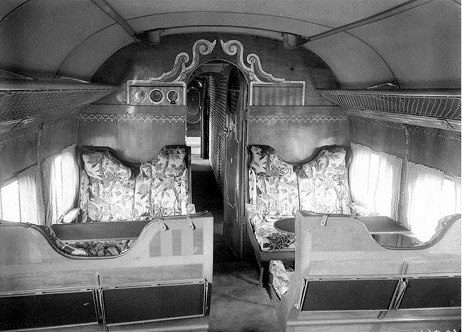
Cabin of a Handley Page HP-42 1931. British Imperial Airways
This luxury is in drast comparison to what we see today, with the introduction of budget airlines in the late 1960s to 1970s. It was a low cost “no frills” which sacrificed traditional airline luxuries for low-cost fares. It operated a low-cost route between Gatwick Airport and New York’s John F. Kennedy Airport (The History Press).
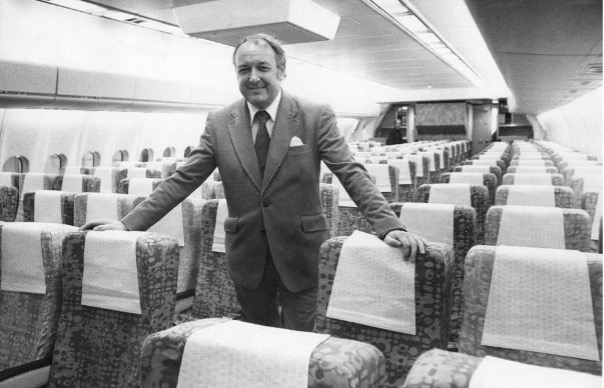
Laker Airways, 1966-1982
We can see the stark difference in spaciousness and luxury between the original Imperial Airways cabin and the low-cost no-frills cabin of Laker Airways.
Take a look at the video below to see how this compares to the low budget airlines of today:
Conclude
It is clear to see that the First World War, in combination with Britain’s imperial endeavours and need for attempted air domination fuelled the development of Civil Aviation. Had it not been for the surplus aircraft and trained pilots left in limbo after the First World War, it is unlikely we would have seen developments at the fast speed they happened. Although the industry was hit with its financial and safety drawbacks, it has developed in to a profitable, popular and advanced mode of transport in the modern day, making itself available to not only those who are wealthy, but to the average citizen too.
Bibliography
Birkhead, E. (1960). The financial failure of British air transport companies 1919-1924. Journal of Transport History.
Higham, R. (1959). Britain’s Overseas Airlines, 1918-1939. Shell Aviation News.
Lyth, P. (2000). The Empire’s Airway: British Civil Aviation from 1919 to 1939. London School of Economics.
Pattillo, D. (1998). A History in the Making: 80 Turbulent Years in the American General Aviation History. McGraw-Hill
Jackson, A. (1973). British Civil Aircraft, 1919-1972, Volume 2. London Putnam.
Thomas, G. (1919). The Aeroplane in Industrial Development, a lecture to the Industrial Council, London.
Woodley, C. (2014). Gatwick Airport: The first 50 Years. The History Press.
Air Ministry, Civil Aviation Department. (1920-21). Civil Aviation Statistics, 1919. Annual Report of the Progress of Civil Aviation.
F. H. Norton. (1921). The Effect of Staggering a Biplane. National Advisory Committee For Aeronautics. https://ntrs.nasa.gov/api/citations/19930080864/downloads/19930080864.pdf
Radio transmitter, from Alcock and Brown’s Vimy biplane, 1919. https://collection.sciencemuseumgroup.org.uk/objects/co8636641/radio-transmitter-from-alcock-and-browns-vickers-vimy-biplane-1919-radio-transmitter
Daily Mail Aviation Prizes: https://en.wikipedia.org/wiki/Daily_Mail_aviation_prizes
M. Santos Durmont Rounds Eiffel Tower. New York Times. https://timesmachine.nytimes.com/timesmachine/1901/10/20/106920457.pdf
Sir Frederick Handley Page, Aviation Pioneer, Is Dead at 76; Invented Slotted Wing in 1921 –Built 60,000 Halifax Bombers in World War II Developed Hastings-Hermes 2 Recent Additions https://www.nytimes.com/1962/04/22/archives/sir-frederick-handley-page-aviation-pioneer-is-dead-at-76-invented.html
House of Commons Debates, 5. Series, Vol.126, 11 March 1920.https://hansard.parliament.uk/Commons/1920-03-11/debates/16ee5039-8636-44dc-9f47-2b5826f95645/CommonsChamber
The Bermudan. (2015). The Fateful Flight of The Cavalier. Retrieved 20 March 2024. https://www.thebermudian.com/heritage/heritage-heritage/the-fateful-flight-of-the-cavalier/
(1939), “British Official Accident — Report: Result of the Investigation into the Loss of the “Challenger” at Mozambique”, Aircraft Engineering and Aerospace Technology, Vol. 11 No. 9, pp. 350-350. https://doi.org/10.1108/eb030541
Handley Page HP. 42. “Giant British Airliner”. Retrieved 20 March 2024. https://planehistoria.com/handley-page-hp-42-giant-british-airliner/
Marsh, A. Huge Biplane Airliner May Fly Again. Retrieved 20 March 2024. https://www.aopa.org/news-and-media/all-news/2014/october/31/huge-biplane-airliner-to-fly-again
Images
The World Areas Covered by Commercial Air Routes 1925. https://en.m.wikipedia.org/wiki/File:The_World_areas_covered_by_Commercial_Air_Routes.jpg
Cabin of a Handley Page HP-42 1931. British Imperial Airways. https://www.dalrc.org/wp-content/uploads/2015/01/Imperial-Airways-circa-1931.pdf
Alcock and Brown taking on mail https://en.wikipedia.org/wiki/Transatlantic_flight_of_Alcock_and_Brown#/media/File:Alcockandbrown_mail.jpg
Videos
British Movietone. (2016). The Cavalier Wrecked. Retrieved 20 March 2024.
FlyWithPetr. (2017). Ryanair Cabin. Sky Interior Walk. Retrieved 20 March 2024.
 Britons Abroad

