Cruises in the modern context are seen as floating fortresses, self-sufficient in a variety of ways from water reclamation to the offerings of a plethora of food, drink and entertainment. However, these modern cruises could not profess such an aptitude for entertainment without first looking back at their earliest ancestors and the opulence they offered for the lucky few who could step aboard.
Since the advent of the steamboat, many utilized them to explore the world and discover very rarely travelled locations of which they could return home to discuss with their friends and family. The earliest steamship that performed the transatlantic crossing was the Great Western in 1838, made entirely of wood and utilised sails as its main source of propulsion (Rodrigue,2020) but only had the capacity for less than two hundred passengers. This showed promise for the transatlantic liner market and proved that there would be a massive economic uptake should the service take off. Unfortunately, these early ships were not as attractive as their iron clad descendants but that was due to technological limitation as opposed to lack of interest. The cruise ship provided luxury and homeliness that was attractive to the upper echelons as it offered the same creature comforts as their beautiful homes on the British mainland. Plus, by intentionally creating such a recognizable atmosphere it encourages passengers to relax and even mingle with people who they would have never encountered save for their journey.
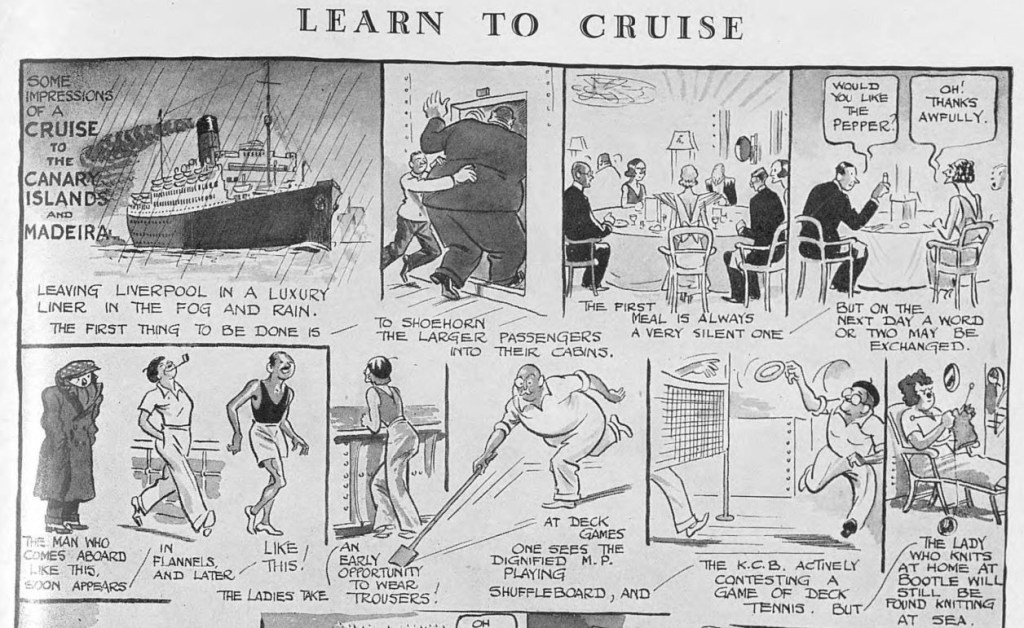
The Tattler – 1933- Depiction of the activities available on cruises in a satirical magazine
As is the case with top of the line must haves throughout most of history, the earlier cruises were tailored to the immensely wealthy who did not have to worry about frivolous spending but there was still the opportunity to purchase a variety of tickets, each with their own benefits. In fact, the Titanics average ticket price was two and a half thousand dollars sixty-one thousand dollars today (Mcinnis,2022), an astronomical sum that ensured all the bells and whistles such as a smoking room, lavish dining, and ambient music. If we were to ask Jack how much his ticket was on the fated ship, his answer would have been a much more respectable seven pounds, this still being roughly eight hundred and forty-nine pounds today. This was deemed an affordable amount as it only amounted to seven percent of an annual skilled workers salary (The Wanderlust Project,2024). However, to compare the third-class ticket with the first is like comparing fire and water. The third-class ticket provided only basic necessities such as toilet access, basic meals and if you were a man, you were lucky enough to have access to male-only smoking area.
Within Glanceys ‘The Journey Matters’ there is a discussion of how many amenities were present aboard the SS Normandie, and it warrants a further analysis to the true extents that people took to genuinely enjoy a cruise. From dog kennels to garages with capacities for 100 cars, it begs the question why would those who are embarking on a water bound holiday need a place to store automobiles and canine companions when neither would serve a greater purpose at sea? The answer itself is tied within the opulence that many cruise liners like the Normandie used as a selling point to entice those with money to burn and the sense to do it whilst in the presence of many of those who were members of the upper class. The lack of amenities for those who paid the least is a sure sign that the cruise liners preferred attracting the wealthy and famous people who saw the cruise as a holiday, one of many that they would be taking throughout the year. Moreover, if well-known lines such as Cunard and White Lines consistently catered towards the upper class, then the repeating customer base would mostly consist of such customers. Whilst discussing the glaring differences between the experiences of those at the top of the ship and those at the bottom, it is important to glean why they had set foot on the boat at all.
Opportunity was becoming synonymous with the United States in the mid 19th century, with there being a presence of every tradable resource from timber and stone to precious metals like gold and silver. By becoming an economic powerhouse, it needed to sustain a workforce that would perform the back breaking labour required to see profits. Due to the country’s size, there was a geographical element to the prominent ethnicities that were a part of the workforce. The east coast had seen a constant influx of migrants from Asia, even more so when the boxer rebellion forced Chinese Christians to have their newly presented privileges revoked and forcefully expelled due to the danger and threats on their lives. However, the west coast was more visited by European nationalities, Scottish, English, Italians to name but a handful of the diverse communities that made the voyage to the ‘Land of Opportunity.’ Circling back to cruises, many of them made several stops in port towns and cities like Boston and New York and so if someone wanted to grasp the unlimited possibilities of the country, they would need to make the transatlantic journey.
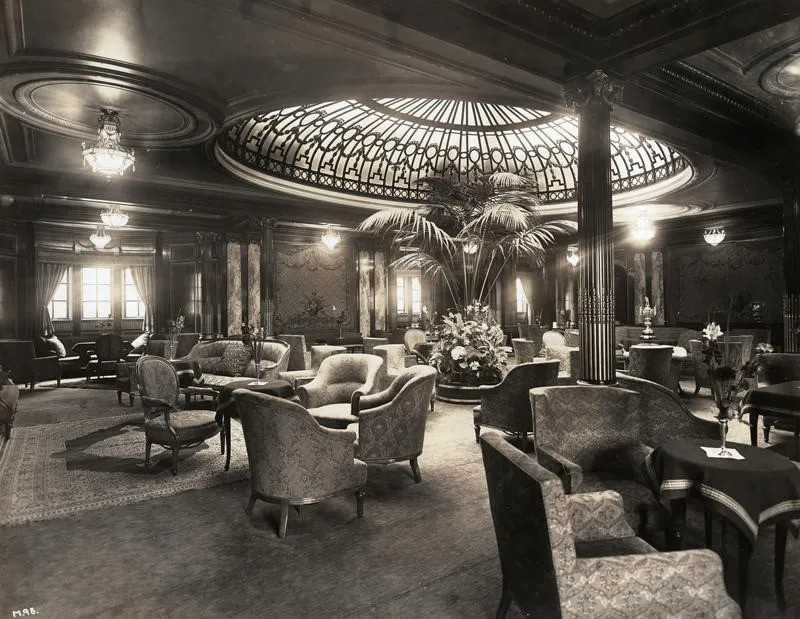
–HMS Lusitania– One of the extravagant lounges aboard the Lusitania
The cruise liners were not the floating cities with every possible enjoyable commodity at the reach of a hand for those who purchased third class tickets. They were a vehicle that was transporting them to a better life away from the turmoil of working-class life in their home countries. A prime example of this is the consistent migration of the Irish diaspora from Ireland to the states fleeing persecution at the hand of the British or the famines that caused millions to starve. With their home country collapsing in on itself due to a foreign colonial power, the USA seems the ultimate place for settling. Cruise liners provided not only an extension of wealthy living but an escape from oppressive powers that were destroying nations as well as a lifeline for the oppressed to use. As such, whilst the rich, famous, and relatively carefree got to enjoy the diverse range of hobbies and amusements abord these revolutionary vessels, there were those quite literally at the bottom, both in the boat and in terms of class , that saw them as an escape and a bountiful oppurtunity to finally establish themselves in a place that would not immediately cast them down due to their nationality. Unfortunately, the end of their journey usually held more of such hatred and bias, with terms like ‘paddy’ and ‘mick’ being used without restraint to belittle and destroy any residual pride within their nationality and even targeted bills like the drunkenness bill that provided widows of habitual drunks’ financial support should their husbands die because of drink.
To conclude, cruise ships were a beacon of radiance and opulence that demonstrated the intertwining of top-of-the-line contemporary technology with gilded age style design. They performed their duty as modes of transportation for those who sought them out to escape from the destructive, dangerous colonial powers that were exerting control over them, but also were floating palaces that provided every home comfort that the upper echelons of society desired. These palaces of the sea were a definitive marker of the changing times as well as the development s in transportation. Moreover, they birthed a new era of exploration for all to enjoy and experience.
Bibliography
Glancey, J (2019), The Journey Matters: Twentieth-Century Travel in True Style, Atlantic Books, Limited, London. Available from: ProQuest Ebook Central. [22nd March 2024].
Khederian,R (2017), Why Gilded Age ocean liners were so luxurious. Availiable at: Why Gilded Age ocean liners were so luxurious – Curbed
Mcinnis,K (2022) Then and Now: Cruise Ship Travel Through the Years .Availiable at :Then and Now: Cruise Ship Travel Through the Years | Far & Wide (farandwide.com)
Rodrigue, J-P (2020), The Geography of Transport Systems, New York: Routledge. Availiable from: https://transportgeography.org/contents/chapter1/emergence-of-mechanized-transportation-systems/liner-transatlantic-crossing-time/
Wanderlust Project, the (2024) How Much was a Ticket on The Titanic. Available at: Why Gilded Age ocean liners were so luxurious – Curbed
 Britons Abroad