For many of you reading this blog today, I am sure some of your earliest holidaying memories likely include ice creams on the rough English coastal beaches of Scarborough, Blackpool, or Falmouth. Perhaps you may have even been fortunate enough to experience the sweltering Spanish sun over the school holidays, complete with your Mum dousing you in sun cream and lounging by the pool – far away from the doom and gloom of English weather. But in the bygone Victorian era of the nineteenth Century, this was a privilege reserved for only the most affluent. Just exactly when did we begin to see the dawn of the all-inclusive getaways we Briton’s are accustomed to today?
This blog will ultimately serve to familiarise you with the fascinating journey and historiography of the “Package holiday” (P.H) as created by Thomas Cook. The UK government defines “The package holiday” as such: “A package holiday is a holiday booking that is sold under one price and contains more than one element. These elements could be but are not limited to flights or other transport, accommodation, car hire, tourism bookings such as cooking classes, city tours, ski trips, etc.” (King’s Printer of Acts of Parliament, 2018). More to the point, historians such as Cormack, have instead highlighted that the package holiday can instead be simply boiled down to “a combination of travel tickets with accommodation”. (Cormack, 1998, p, 102).
The birth of organised travel: Thomas Cook
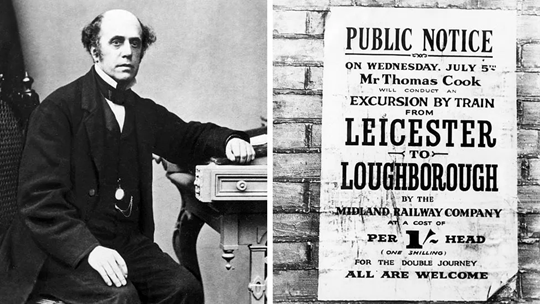
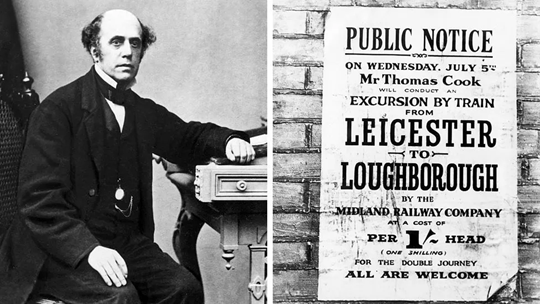
- Figure 1: Thomas Cook alongside advertisement for his first train excursion (BBC News, 2019)
Some historians, such Richardson believe the package holiday began in the 1950s, courtesy of “Vladimir Raitz” (Richardson, D. p1. 2016) – I instead believe that it was actually in the early 19th Century that we saw the original package holiday in the UK. Organized by Thomas Cook and Sons, the excursion was a humble 22-mile train journey from Leicester to Loughborough that commanded just over a shilling (around a day’s wages at the time). It saw 500 passengers, for many of which, was their first time travelling by steam train, and upon the train’s arrival in Loughborough, the passengers were greeted by brass bands and celebratory crowds. Though this particular locomotive excursion wasn’t profitable for Cook, it ultimately demonstrated there was an untapped market for enabling tourism; as Cook stated – given the accessible opportunity people would: “Go beyond.” (Thomas Cook, 2024)
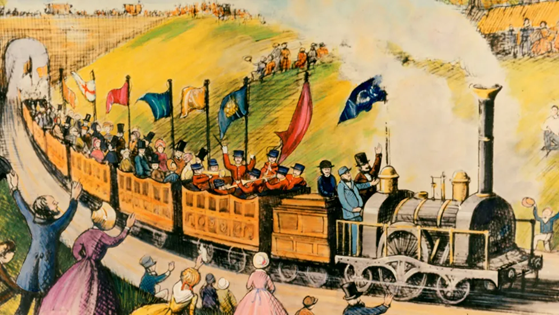
- Figure 2: The 22-mile journey – (BBC News. 2016)
Global expansion and innovation
Over the Century, Cooks’ epiphany in tandem with the rapid Industrialisation and technological advancements taking place in Europe laid the foundations for the package holiday to bloom into the entity we recognize today. For instance, burgeoning railway networks, the widespread adoption of steam power and revolutions in telegraph capabilities facilitated Cooks package holidays to eventually reach the farthest corners of the globe. Firstly: the expansion of railways across Europe provided Cook with a continuously growing number of destinations, in a comfortable and reliable mode of transportation. Secondly: by 1850, steam power greatly accelerated nautical voyage times. Cutting the trans-Atlantic crossing from on average 40 days, to only 16 (Gourevitch, A. 2023). Finally, Morse code and the telegraph – invented in 1832 by Samuel Morse – had begun to be adopted throughout Europe and Asia by the early 1850s, enabling Cook and holidaymakers almost instantaneous communication across entire continents. This feat largely eliminated the process of letter writing, unreliable postage, and torturously long waits. (Google arts culture, 2013)
A turning point: an Egyptian expedition

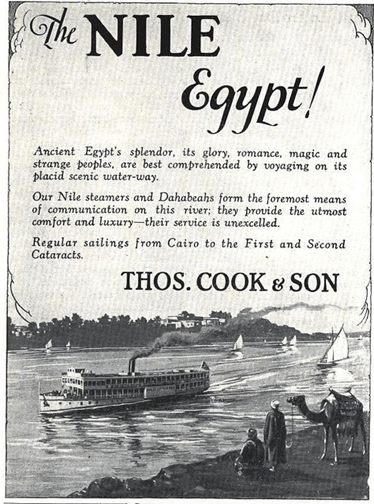
- (Left) Figure 3 : Cooks Nile steamer advertisement. (WordPress, 2012)
- (Right) Figure 4 : Advertisement for Cooks Nile expeditions (Agefotostock, 2024)
After nearly thirty years of establishing his footing in Europe, and working closely with the temperance anti-drinking movement, it was in 1869 that a turning point for Cook and the package holiday industry emerged. The reason being, in the same year of 1869, the Suez Canal was inaugurated, opening a sea route to the Orient and the potential for tourism. Seeing the opportunity to grow his business abroad, Cook hired two steamers from the Khedive – Ismail Pasha – and organised a three-month guided group expedition along the banks of the Nile, showcasing the ancient wonders of Egypt. (WordPress. 2012) Consequently, sparking the era that Humphreys described as: “The golden age of (Nile) travel” (Humphreys, A. 2015). The trip saw ten wealthy travelers, divided into two groups, and placed on separate Egyptian steamers, the Benisuef and the Benha, everything – food, lodging, transportation, entertainment, sightseeing – was included, for one flat price. Previously used to exploring places like Vienna and Paris the guests were instead exposed to an entirely different world. Including a completely different climate and archaeological and historical sites far from anything the travelers (some of which can be seen below in figure 5) had ever seen. (Yehia, E. p. 46. 2020)
Crucially, while Cook had enlisted the use of steamers before, he had never done so in this format. Cook showcased the abilities of steamers to serve as moderately luxurious floating hotels, allowing his passengers to explore the banks and sites of the Nile without sacrificing the comforts and commodities of inland hotels. Ultimately, demonstrating the potential of steamers as a viable options for long distance and endurance journeys, paving the way for the rise of cruise tourism in the decades to come. The immediate success of the first trip had several impacts on Cooks’ career and the tourism industry. Firstly; it served to heighten even further the esteem in which Cook was heralded as an organizer, immediately flooding him with wealthy individuals clamouring for the opportunity to escape European winters for an exotic break. And secondly; in terms of industry and infrastructure, this high demand necessitated the 1870 opening of a Cook run holiday office in the Shepheard’s hotel Cairo, expanding the network for cross continent tourism. And thirdly; it set in motion the growth of Steamers as a tool for tourism. (One could even argue as a precursor for the aviation industry.)
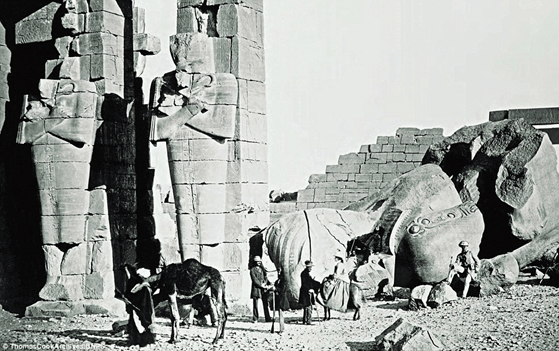
- Figure 5: Cooks tourists pose in front of the Ramesseum, 1869. (BBC News. 2015)
Cooks Steamer dominance of the Nile.
Several years after the initial trip to Egypt that Cook obtained the initial concession from the Khedive Ismail Pashin that permitted his monumental Nile journey, two events took place up that would establish his dominance over the Nile, and set the wheels in motion that would make the exotic package holiday accessible to the middle class in Britain. Firstly, in 1875, Egypt – due to several factors, went bankrupt, and thereafter became a Franco-British protectorate. Consequently gifting Britain complete control of the Suez Canal (Which would set the stage for several conflicts with the Ottoman empire), and therefore, Britain came to establish dominance over Egypt. The impact of this was Egypt – in particular the river Nile – through the excellent reputation of Cooks tours and British troop presence found itself as an ideal, safe hotspot for eager British, and other European tourists. (Sherrin, H. 2022)
Come 1880, Cook and Sons were granted absolute concession over all river travel by the new Khedive, Tewfik Pasha the son of Ismail Pasha. Cook naturally gained access to more steamers to accommodate the increased influx tourists, however, only four years later in 1885, these would be requisitioned by the British military as troop transports in a campaign in Sudan – all of which came back severely damaged a year later in 1885. This gave Cook the opportunity to construct his very own fleet, built in Scotland, and transported to Cairo disassembled where they were later reassembled in the ports along the Nile. Consisting of “The Prince Abbas”, “Prince Mohammed Ali”, and two “Rameses” steamers; the later capable of transporting up to 80 passengers. (Steamship Sudan. n.d)
Cooks Steamer fleet and a growing middle class
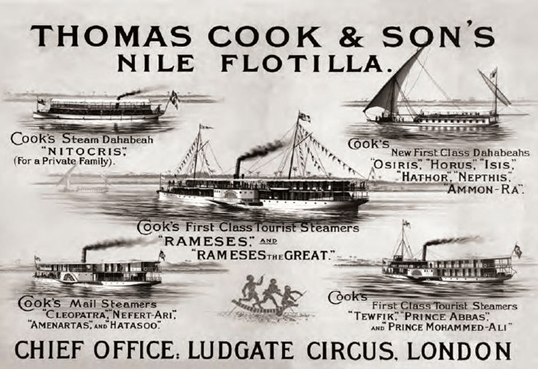
- Figure 6: Advertisement for the Thomas Cook Nile fleet. (Egypt Paddle ships. n.d)
The Cooks name had become synonymous with everything important to a would-be British tourist, safety, efficiency, luxury, and familiar British practice. This perception of Cook, and his business owning its own independent fleet (now operated by John Mason Cook), in tandem with his own hotels, ports and offices along the Nile banks and greater Egypt meant that in the closing decades of the 19th Century and the dawn of the 20th Century, his business had more control over tourism both in Egypt and worldwide. Crucially, it granted him freedom to essentially do whatever he wanted with his business. Including, challenging the established elites of society, by decreasing the high fares for his services in Egypt – opening opportunity for the growing middle classes of Britain.
The subject deserves its own article, but for this purpose, in short: the industrial revolution in Britain was facilitating vertical social class migration for workers in the country. Increased factory employment and demand for artisan and skilled workers and the establishment the Trade Unions congress in 1868, facilitated, as Carnevelli described “the rise of mass consumerism… generated by real wages after 1870…and mass literacy.” (Carnevali, F. p.30. 2014). More broadly speaking, this era is when we can begin to trace the growth of people progressing into the middle class, and the population in Britain slowly obtaining disposable income. It was that very demographic that Cook was able to target and present the opportunity over the subsequent decades, that would be survived by John Cook after Thomas Cooks death in 1892.
Legacy and impact
As the 20th Century dawned, following the death of Thomas Cook in 1892, and John Mason Cook in 1899, the company entered a new era as control passed to the three grandchildren, Frank, Ernest, and Thomas (Bert). From this point, the company would face a tumultuous journey that would see the company become synonymous with British identity and widespread accessibility as a package holiday organiser. As Morris described in 1968, Cooks became: “the booking clerk of the Empire… ‘leave it to Cook’s’ had gone into the language. Cook’s had virtually invented modern tourism, and their brown mahogany offices, with their whirring fans and brass tellers’ cages, were landmarks of every imperial city.” (Morris, J. p, 64. 1968)
From opening the package holiday up to a wide array of Britons and tourists from all social classes, 1922 guided Safari tours through Africa, their first air tour in 1927 from New York to Chicago; privatization, multiple ownerships and countless hundreds of thousands of miles travelled from all walks of life; even after their declaration of bankruptcy in 2019, Thomas Cook and their tagline “don’t just book it, Thomas Cook it!” will be forever immortalised for people all over the world – like me, that have been fortunate enough to travel with a company so rooted in British history. (Cripps, K. 2019)
Billy Stephens, 2024
References
Images
- Figure 1
Thomas Cook: The Much-Loved Travel Brand with Humble Roots (2019) BBC News [Online], 23 September. Available from: <https://www.bbc.com/news/business-49789073> [Accessed 27 March 2024]
- Figure 2
Thomas Cook Steam Train Marks 175th Year since First Excursion (2016) BBC News [Online], 4 July. Available from: <https://www.bbc.com/news/uk-england-leicestershire-36672483> [Accessed 27 March 2024].
- Figure 3
Rehabsaad.2012. https://rehabsaadblog.wordpress.com/tag/thomas-cook/
- Figure 4
agefotostock (n.d.) Brochure Front Cover Advertising Thomas Cook’s Tours to Egypt, the Nile and Soudan [Online]. agefotostock. Available from: <https://www.agefotostock.com/age/en/details-photo/brochure-front-cover-advertising-thomas-cook-s-tours-to-egypt-the-nile-and-soudan/MEV-10224771> [Accessed 27 March 2024].
- Figure 5
Amey, K. (2015) Fascinating Book Chronicles Rise of British Travel Agent Thomas Cook [Online]. Mail Online. Available from: <https://www.dailymail.co.uk/travel/travel_news/article-3197583/The-humble-package-holiday-s-surprisingly-upper-class-origins-New-book-chronicles-rise-travel-agent-Thomas-Cook-pioneering-jolly-Nile-alongside-Britain-s-wealthiest.html> [Accessed 24th March 2024].
- Figure 6
Egypt (n.d.) [Online]. Available from: <http://www.paddlesteamers.info/Egypt%20Historical.htm> [Accessed 21st March 2024].
Information/quotations/miscellaneous
- 1
The Package Travel and Linked Travel Arrangements Regulations (2018) [Online]. Available from: <https://www.legislation.gov.uk/ukdsi/2018/9780111168479/contents> [Accessed 20 March 2024].
- 2
Cormack B. Jemima, M. (1998). P.108. The history of tourism: Thomas Cook and the origins of leisure travel, Routledge London
- 3
Richardson, D. p.1. (2016) Let’s go! a history of package holidays and escorted tours.
- 4
Thomas Cook (n.d.) About Us [Online]. Thomas Cook. Available from: <https://www.thomascook.com/about-us> [Accessed 20 March 2024].
- 5
Gourevitch, A. Discover Walks Blog (2023) Great Innovations in Travel: Steam Power [Online]. Discover Walks Blog. Available from: <https://www.discoverwalks.com/blog/columnist/alexandre-gourevitch/to-what-do-we-owe-the-pleasure-of-this-visit-great-innovations-of-all-times-in-travel-steam-power/> [Accessed 20 March 2024].
- 6
Google Arts & Culture (n.d.) A Brief History of the Telegraph [Online]. Google Arts & Culture. Available from: <https://artsandculture.google.com/story/a-brief-history-of-the-telegraph/7wVxhgrMyafyKQ> [Accessed 20 March 2024].
- 7
Word press, (2012). https://rehabsaadblog.wordpress.com/tag/thomas-cook/.com
- 8
Humphreys, A. (2015) “On the Nile in the Golden Age of Travel”.
- 9
Yehia, E. (2020) The Politicization of Early Egyptian Tourism. Journal of Association of Arab Universities for Tourism and Hospitality, 0 (0) June, pp. 46-49
- 10
Sherrin H. History Hit (2022) Thomas Cook and the Invention of Mass Tourism in Victorian Britain [Online]. History Hit. Available from: <https://www.historyhit.com/thomas-cook-invention-of-tourism/> [Accessed 30 March 2024].
- 11
Steam Ship Sudan (n.d.) The Day of the Steamers [Online]. Steam Ship Sudan. Available from: <https://www.steam-ship-sudan.com/en/journal/the-day-of-the-steamers/> [Accessed 30 March 2024].
- 12
Carnevali, Francesca. (2014). P34. Twentieth Century Britain: economic, cultural, and social change. VleReader (n.d.) [Online]. Available from: <https://r1.vlereader.com/Reader?ean=9781317868378#> [Accessed 22 March 2024].
- 13
Morris, J. (1998). Pax Britannica: The Climax of an Empire. London. P.64
- 14
Cripps, K. (2019) Thomas Cook: A History of One of the World’s Oldest Travel Firms [Online]. CNN. Available from: <https://www.cnn.com/travel/article/thomas-cook-history-timeline/index.html> [Accessed 30 March 2024].
 Britons Abroad