When you are booking a holiday, you may embark on a cruise, a cultural holiday, or even a city break. However, the late 1930’s saw the package holiday take centre stage to become one of the most popular holiday options in Britain. A package holiday can be defined as a holiday that is organised by a travel agent and includes accommodation, transport arrangements and sometimes tickets to attractions or events. There are many factors in post-war Britain which caused the rise of the package holiday. The first is the harsh weather conditions that the British public were faced with as ‘the winter of 1946-7 in Britain had been the coldest on record’ (Spellman, 2020, n.p.) Consequently, there were electricity shortages, the government encountered problems importing coal and newspaper printing came to a halt. It is understandable that the British wanted to escape the cold and war-torn conditions that they were experiencing at home and with travel becoming more accessible allowed them to do just that. A move away from scheduled flights in favour of chartered flights gave people more freedom and choice, while ‘the Second World War had left even remote islands with a new asset: airstrips’(Lofgren, 1999, pp.173,) thus opening up new destinations for people to visit. Moreover, attitudes towards holidays themselves changed as they became more accessible to the masses.
Previously, the long 18th century saw holidays to be associated with young, male elites with the educational expectations of acquiring new skills and broadening their knowledge. In post-war Britain, this was no longer the case because package holidays made them no longer a luxury, but something anyone could embark on regardless of their gender or class. The package holiday was able to offer the British a holiday in Spain, for example, ‘at a far less cost […] than dreary and cold vacations in their own homeland’ (Seth, 2006, 313.) Value for money was important to Britons going abroad which is shown through a British Europen Airways promoting package holidays for the summer of 1959. From the beginning of the brochure, readers are told that the holidays available are ‘cheaper than ever before’ (BEA, 1959) and this is a theme that is repeated throughout, showing that this was a predominant concern amongst British holidaymakers.
Don’t worry, you’re on holiday!
Picture your stereotypical Briton abroad, frantically searching for anywhere that serves a Full English breakfast and making no attempt to indulge in the local language or culture. According to Gavin Jack and Alison Phipps, when we are abroad, we ‘play the role of alienated moderns’ (Jack and Phipps, 2005, n.p) and this ultimately led to the package holiday to be standardised to create a sense that British holidaymakers were at home away from home. Orvar Lofgren explains the way in which the package holiday were designed was ‘meant to eliminate much of the anxiety-ridden skills of mastering foreign language proficiency, or the etiquette of public behaviour in hotels and restaurants.’ (Logfren, 1999, pp.205) which was reflected by Harry Ritchie’s account of his 1993 holiday to Fuengirola as he highlights that ‘you do not have to worry about how to work a foreign country […] because it’s all taken care of’ (Ritchie, 1993, pp.15.) It is true that this standardisation ran from the beginning of the package holiday to the very end. This is evident as soon as Ritchie stepped off his flight as ‘the Thomson woman pointed me through the door to another Thomson woman who pointed me to a bus ten yards away’ (Ritchie, 1993, pp.15) This shows just how regimented the package holiday was from the minute is began. The conformity continued as you would encounter the same tour guides and activities throughout the course of your stay. Ranging from the food and drink available, to claiming your sun lounger by the pool side, daily routines were important and a pattern which emerged due to a rise in the popularity of the package holiday.
Outside of the direct standardisation of the package holiday itself there were more ways to fulfil the need to make the surroundings feel familiar to the British people. British people seeking the feeling of Britishness played a huge role in shaping the package holiday. Figure 1 was taken in Majorca in the 1980s and if it wasn’t for the sun, it could be mistaken for being in Britain. After all, what gets more British than a pub named after a member of the royal family? Every detail of the image, including the use of the colours red, white and blue, are representative of a British audience. The fact that the takeaway, pub and shops are all positioned together emphasises how Britain was almost condensed to allow people to continue to experience their own country while on a package holiday. If that was not enough, British holiday makers could get their hands on ‘essential’ British products. Nowadays, your average Briton abroad would not survive a few hours without a tea bag and going back a few decades, the same can be said for British cigarettes and the daily newspaper. Luckily, the BEA travel brochure promoting package holidays informs readers that ‘English newspapers are on sale at most bookstalls. English cigarettes are obtainable too’ (BEA, 1959.) The availability of everyday British products introduced another layer of comfort to the package holiday. As British cigarettes in particular were on the more costly side, this was further achieved through the British taking their own products to use while on holiday.
![Sykes, H. (1980s) Photograph taken in Majorca, Spain [Online image] Available from: https://www.alamy.com/1980s-tourism-spain-magaluf-majorca-english-owned-bars-restaurants-image4114638.html](https://britons-abroad.co.uk/wp-content/uploads/2022/04/majorca-2.jpg?w=640)
Package holidays were not all filled with sunshine and sand
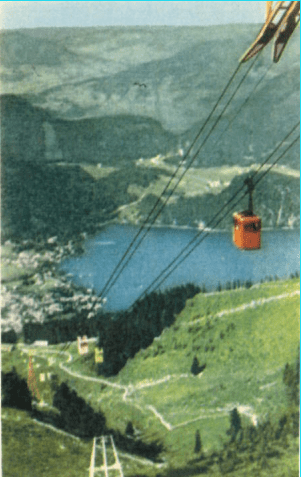
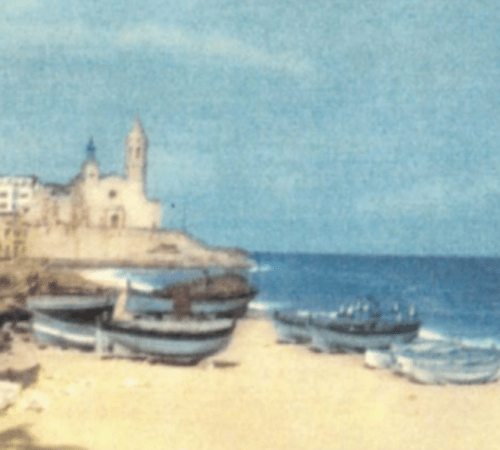
Perhaps it is easy for us to presume that the formulaic approach to the package holiday led to Britons abroad to have the same experiences. However, this was not the case as people could add their own meanings to their package holiday. While abroad, the British applied their beliefs and expectations to degrade what they saw. This is evident in comparisons made between the travel brochure and what they actually experienced while on their package holiday. The BEA travel brochure used descriptive language such as ‘Spain- where the sun blazes down all day, and the nights are balmy and star-studded’ (BEA, 1959,) presenting a utopian view of a package holiday. This is reinforced through the images used on the BEA travel brochure which show the idea of a paradise contrived brochure zone (Dann, 1996) which was done to show off the natural beauty and architecture of the countries. Figure 2 highlights the picturesque landscape of Austria with greenery and mountains which were romanticised in British literature at the time and by visitors. Similarly, Figure 3 gives readers a taste of the sunlit beaches and deep blue sea that British holidaymakers had the opportunity of visiting. On the other hand, Ritchie’s hotel that had ‘looked intriguing in the brochure’ (Ritchie, 1993, pp.19,) but upon arrival it was ‘ghastly’ (Ritchie, 1993, pp.19.) In his account, Ritchie continues to express his discontent of the conditions he was presented with. As a result, the contrast of the appealing imagery on the travel brochure and what people experienced creates a division between the expectation versus reality. There was an element of risk to embarking on a holiday overseas which Richie exemplifies. If expectations were not met, the meaning that the package holiday had to the holidaymaker could change.
In addition, there are many instances in which British people presented themselves as superior to the locals. This is a criticism identified by Martin Farr who argues that package holidays results in a feeling of ‘moral superiority’ (Farr, 2013, pp.118.) While on a coach, Richie identifies that there is ‘obviously, on the left, another hotel and some very badly parked cars’ (Richie, 1993, pp.17) and it was the ‘badly parked cars that was our eventual undoing’ (Richie, 1993, pp.17) which led to complaints from fellow passengers. The use of the term ‘obviously’ is conveyed in a disapproving tone which suggests the locals were hindering his holiday experience by, as he presents them, being careless and inconsiderate. As representations of locals were missed in favour of promoting the British aspect of the package holiday, it suggests the way local life was imagined was artificial and unrealistic, resulting in a self-centred approach from Britons abroad.
The rise of the package holiday is important when assessing how travel has evolved. Although the standardization of this type of holiday created a sense of package holidays being a shared experience, they marked a transition towards independence and British people using them for purposes specific to the individual. Also, the feeling of Britishness became characterised by stereotypes, some of which we still see today while on a holiday outside of Britain. The package holiday becoming mainstream in British society due to it becoming affordable to people outside of the upper class, combined with the impact of the Second World War created conditions for the transformation of travel.
Bibliography
Primary sources
Sykes, H. (1980s) Photograph taken in Majorca, Spain [Online image] Available from: https://www.alamy.com/1980s-tourism-spain-magaluf-majorca-english-owned-bars-restaurants-image4114638.html [Accessed 26 March 2022]
Ritchie, H. (1993) Here we Go: a summer on the Costa Del Sol. London: Penguin.
British European Airways (1959), The Happiest Holiday of All.
Secondary sources
Dann, G. (1996) The People of Tourist Brochures. In Selwyn, The Tourist Image: Myths and Myth Making in Tourism. Chichester: Wiley, pp. 61-103.
Gavin, J, Phipps, A. (2005). Tourism and Intercultural Exchange: Why Tourism Matters. Channel View Publications.
Farr, M. (2013) The Lacunae of Heliosis: Package Holidays and the long 1970s. In Farr, Martin & Guegan, Xavier (eds) The British Abroad Since the Eighteenth Century, Vol. 1: Travellers and Tourists. Basingstoke: Palgrave Macmillan, pp.117-138.
Lofgren, O. (1999). On Holiday: A History of Vacationing. University of California Press.
Seth, P. (2006). Successful Tourism Volume II: Tourism Practices. Sterling Publishers.
Spellman, W. (2020). A Concise History of the World Since 1945: States and Peoples. Bloomsbury Publishing.

